
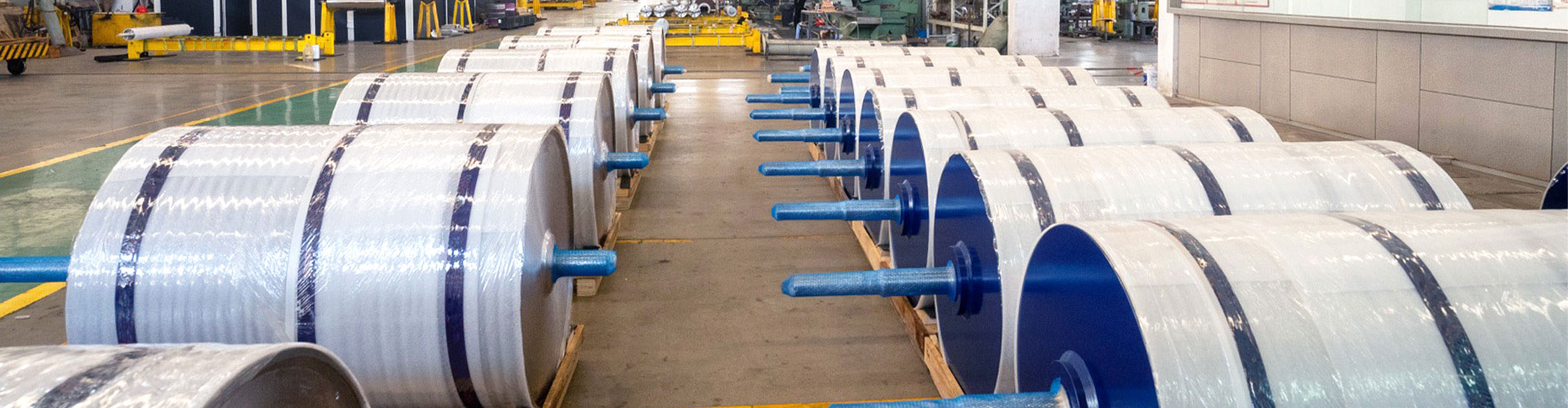
As modern manufacturing keeps on developing in terms of speed, automation, and precision, requirements for temperature control at industrial production plants have gone higher. From plastic film extrusion, rubber calendering, and lithium battery electrode manufacturing, to steel processing, papermaking, printing, textiles, composite materials, and the new energy industry, virtually all production processes that involve heating, calendering, hot printing, coating, or melt molding depend heavily upon efficient and stable cooling systems. In fact, industrial cooling rollers are undoubtedly the most vital equipment besides temperature controllers in the entire temperature regulation system.
Certain people believe industrial cooling rollers are just metal drums with water flow, but the truth is, industrial cooling rollers of the modern age have developed into a variety of structural types and are applied differently. On the one hand, different cooling rollers can be used to cool products quickly. On the other hand, they could have a direct impact on the dimensional stability of materials, surface smoothness, internal stress distribution, product gloss and the final product quality. In fact, the well-designed cooling roller with the good thermal distribution can even make the products yield increase significantly, scrap rate decrease and the costs related to maintenance of equipment become more favorable, in especially high-end manufacturing processes.
In fact, from industrial statistics, it has been shown that about 20% to 35% of all process defects in plastics processing, lithium batteries, optical films, and metal processing products are attributed to improper cooling control. Good design of the industrial cooling roller system will not only ensure over 15% improvement in product dimensional consistency but also reduce thermal deformation and surface defects. It is evident therefore that, with industrial cooling rollers being no longer the regular pieces of machine equipment, their function will remain in deciding the product quality as the major industrial production devices of today.
Which coolers are being used in the industries apart from the mentioned ones? The types of coolers used in the manufacturing industry and the various factors distinguishing them will be the subject of this article. Finally, the methods for choosing the most suitable coolers for a company in its process of manufacturing will also be covered in detail in the article below which is supposed to give the readers a comprehensive overview of the industrial cooling rollers.
What is the reason that more and more cooling rollers are being needed in the modern industries?
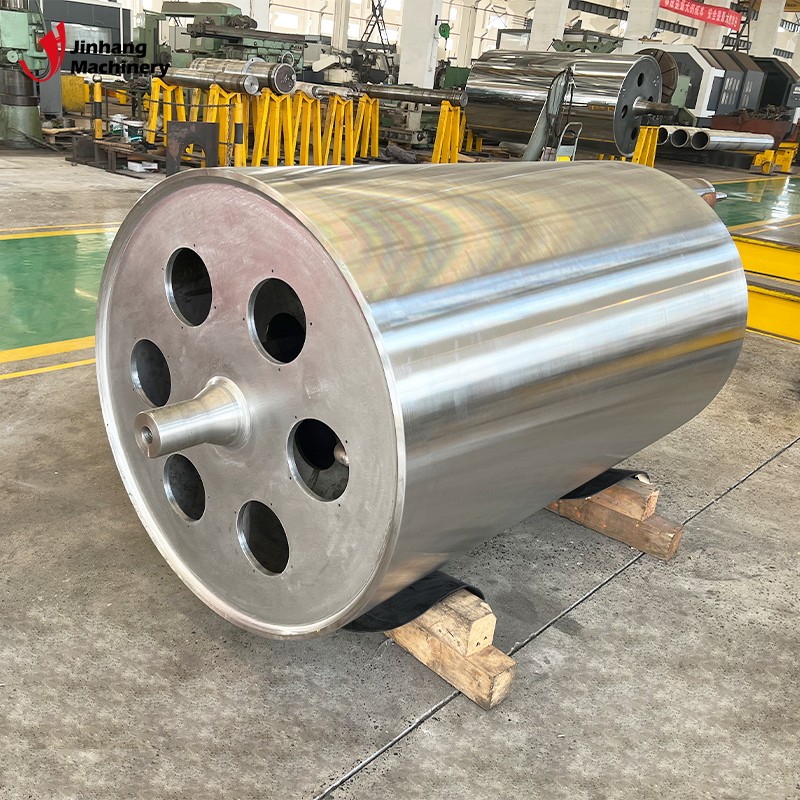
Rollers of industrial cooling are used as rollers in which heat generated during processing is rapidly removed with the help of an inner cooling medium. They are usually fabricated with carbon steel, stainless steel, or alloy steel, and their interiors are provided with different types of cooling flow channels. Water, chilled water, or some other cooling medium is continuously circulating in them to preserve a constant roller temperature. Heat is transferred by physical contact between the roller surface and the product.
Since the temperature of materials being processed is raised very high in many areas of manufacturing, the need for a quick cooling system is quite high. In other words, for plastics, granules have to be melted then extruded; rubber is pressed by hot-pressing; lithium battery electrode requires a stage of drying before further processing can commence; and metals require to be hot-rolled or annealed. Failure to cool the materials fast enough will not only lead to an issue in the accuracy of size but may also cause shrinkage problems, twisting and deforming, a decrease in surface shiny effect and a change of internal structure. Hence, industrial cooling rollers contribute significantly to the shaping of the products.
Because the production speeds are continuously rising, the modern industries are putting even greater demands on cooling rollers. Quite a number of fast lines running at a thousand meters per minute are available. If the cooling capacity of the cooling rollers is inadequate, materials may undergo the following process before they are completely cooled, which results in continual quality issues. So nowadays, companies are not only looking if the industrial cooling rollers are able to cool, but are also concerned about their ability to maintain uniform temperatures across the entire roller surface and to operate without failure for an extended period of time.
Cooling roller types according to internal structure: What are the most common industrial cooling rollers?
Currently, if it is only about the types of cooling rollers that can be classified according to their internal cooling structure, the following are the most common ones.
1. Standard straight-through industrial cooling rollers
Actually, it is the most common type among straight-through cooling rollers that can still provide sufficient cooling in many manufacturing processes. However, if longer roller or higher processing speed is involved, the temperature distribution may be different at various points of the roller surface due to the non-uniform flow of coolant in the straight-through channel.
2. Spiral flow channel cooling roller for industrial use
One method for increasing heat exchange of cooling medium is to use spiral flow channel cooling rollers. Inside of the roller, spiral channels are arranged and connected so that the cooling medium can flow to the entire roller and thus, the contact area between the cooling medium and the roller is increased and the effect of insufficient local cooling is reduced. Generally, industrial spiral flow channel cooling rollers improve heat exchange efficiency of cooling medium by 20% up to 40%, which is why they are used in the production lines for PET film, BOPP film, optical film, and other new material.
3. Double spiral industrial cooling rollers
Double spiral cooling rollers represent the other high-tech variety that can achieve excellent performance by means of a symmetrical arrangement of flow channels inside the roller. In this case, the cooling medium from both sides meets the center of the roller and forms a more balanced flow path that helps to significantly reduce the roller surface temperature difference at the expense of only marginal flow losses. Based on industry data, the use of high-quality double spiral cooling rollers allows one to limit temperature differences across the entire roll to as little as ±1℃ whereas with high-end products one can get as close as temperature uniformity within ±0.5℃, which makes this type of industrial cooling roller suitable for the production of electrode sheets of lithium batteries, optical films, electronic materials, etc., which are all highly precision industries.
Classified by Surface Treatment: Which Industries are Different Cooling Rollers Suitable For?
If the only classification considered is that one that the cooling rollers can undergo in terms of their surfaces treatment (different surfaces will meet various industrial requirements), then different types of cooling rollers have been developed to suit the different surface treatments. The surface quality of the product is quite different for different industries, hence, various types of cooling rollers have found their way into the application of cooling. For instance, in high-end manufacturing industry, mirror finish cooling rollers are the most prevalent because the rollers go through precision grinding as well as ultra mirror polishing so the surface roughness Ra value is usually 0.01–0.05 μm, while some even reach Ra < 0.005 μm, as for optical grade products. Mirror finish cooling rollers on one hand can very fast draw out the heat from the product, while on the other hand they can produce the most shiny and smooth surfaces with the products, which makes them very popular in the production of PET film, CPP film, optical film, acrylic board, and different transparent packaging materials.
Matte cooling rollers are the opposite kind that mirror finish cooling rollers, and they are more suitable for those kinds of products which need features such as anti slip, matte, or special textures, and are used in the production of industrial conveyor belts, anti slip flooring, functional films, and some packaging materials.
In addition to chrome plating industrial cooling rollers are an extremely common product. Through electro deposition of hard chrome to add surface hardness, the hardness of chrome plating layer is generally HRC 60 or so, which gives a very good wear, Corrosion and scrapping resistance, as a result they are extensively used in paper making, printing, plastic calendaring and general industrial processing. Surface strengthening treatments such as Tungsten carbide or Ceramic spraying are also used in high load applications to enhance the service life of industrial cooling rollers.
Cooling roller types typical for the different industries?
It is true that we have many different types of cooling rollers; however, what one chooses is dependent to the particular industries and their respective requirements.
One industry which has been identified to have the highest use of rollers is the plastic film manufacturing industry. Basically all kinds of plastics like PET, PP, PE, PVC etc. that have been cast in extrusion would need rapid cooling via industrial cooling roller in order for material to crystallize or set. Almost all the production lines have been set up as mirror polished cooling rollers with spiral or other similar cooling channel combinations so as to achieve fast and even cooling.
The battery sector also witnessed a significant rise in the demand for industrial cooling rollers. Temperature regulation at the electrode coating, rolling and separator stages is one of the factors that affect the thickness uniformity of materials and the performance of batteries. For that reason, most machines are combined with a high-precision double-spiral roller and an automatic temperature control system to enable precise temperature adjustments across the entire Roller.
Corrosion Resistance and wear are the key for the paper industry, hence, chrome-plated or stainless steel industrial cooling rollers are the right choices to prevent the long-term deterioration caused by the paper-making processes that are always moistening and mixing chemicals. As for paper-making that takes place for a very lengthy period of time, the industrial cooling roller is required not only to have the mechanical strength, Fatigue resistance, etc., but should also have great durability against any sort of damage.
Industrial cooling rollers in Steel and Non-ferrous metal processing industries have to operate for a long time at relatively high work temperatures and under heavy loads so such types of Industrial cooling rollers are typically made of high-strength alloy steel and equipped with a highly efficient cooling channel design to ensure that their cooling effectiveness does not drop over time.
How should companies choose the suitable industrial cooling rollers for their needs?
Not only should the cost, the company's selection of industrial cooling roller be made after a comprehensive consideration of factors like, processing requirements, properties of the material, speed of production, and the costs of long-term operation.
The first thing to be done is to choose the type of the industrial cooler according to the material to be worked with. Different metals have different rates of thermal conduction, e.g., PET film and rubber require entirely different cooling times, and therefore appropriate types of industrial cooling roller structures need to be chosen.
Next, industrial cooling roll heat transfer capacity should be decided based on the production speed. It generally needs a more efficient spiral flow cooling or a twin-spirals cooling roller on a production line operating at high speeds. The production unit can get away with using a simpler structured industrial cooling roller.
In addition, the correct type of roller surface treatment is mainly the one that depends on the surface characteristics of the product. In case the product is going to demand high transparency as well as mirror finish one should prefer mirror finish cooling rollers, whereas if there is a wear environment, chrome-plated cooling rollers may be the way to go or other abrasion-resistant measures.
At the same time companies should pay attention to the uniformity of the roller surface temperature, dynamic balance of the roller, flow rate of the coolant, design of the interfaces and long-term maintenance cost of the industrial roller cooling. If an industrial cooling roller is of the highest quality, although it comes with a much higher purchasing price, its usage can lead to shorter breakdowns and a more homogeneous product, hence, a cost-effective solution in a long perspective.
What are frequently asked questions?
Q1: Which type of the cooling roller is usually adopted as the standard one in the industry?
Owing to the fact that the common types include ordinary cooling rollers, cooling rollers which are equipped with channelized flow of cooling medium and mirror-polished ones, but the spiral channel ones are gaining the popularity in high-tech manufacturing, because they do a better job in heat transfer as well as in temperature uniformity on the roller surfact.
Q2: Why has surface mirror polishing become another popular requirement for industrial rollers other than temperature control?
Surface polish of roller to the mirror level can significantly increase the smoothness and luster of the product's surface that is in contact with it, and it avoids making any depressions or marks on the product surface due to roller roughness. These features make such coolers particularly suitable for processing optical films, PET films and high-class plastic sheets.
Q3: Why is it decided to have a spiral channel inside the roller cooler?
The length of the path for coolant is one of the reasons behind the decision of having spiral channel, the other is the improvement of heat transfer and even temperature distribution over roller surface in a way that will benefit the production in terms of product quality and dimensional precision.
Q4: Should the industrial roller coolers be maintained on a regular basis?
The manufacturers are to inspect the cooling channels inside the roller for possible clogging. Then check whether the surfaces have any scratches or wear. Besides, a check on the rolling bearings' condition is required. Flow rate and temperature monitoring of the cooling medium will also help in ensuring the cooling rollers remain efficient and working properly in the long-term.