
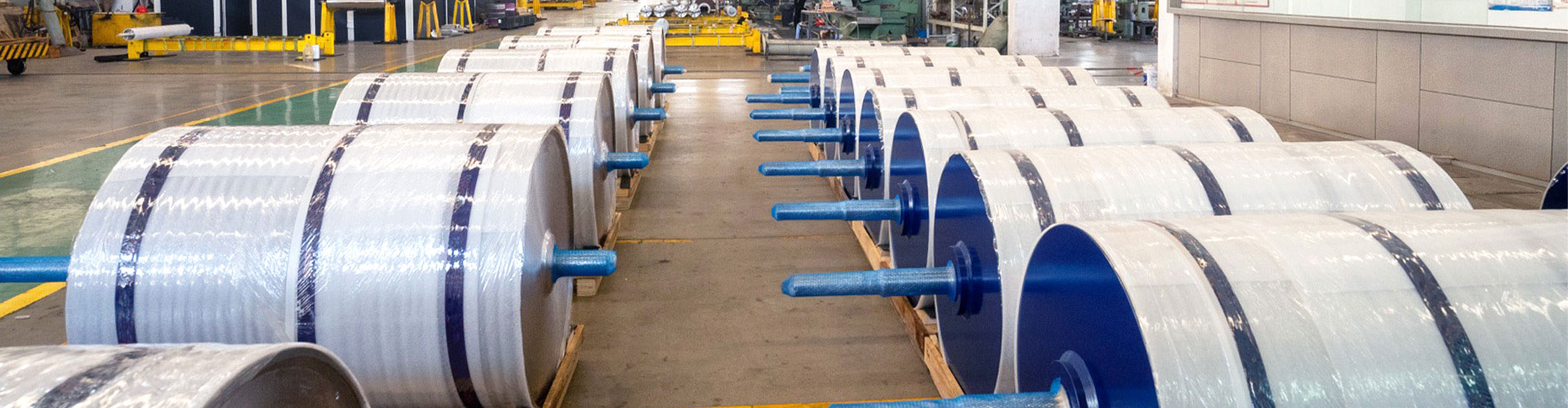
In continuous production industries—such as film processing, coating, printing, lamination, papermaking, rubber and plastics, textiles, and lithium-ion battery materials—heating rollers are essential equipment for heating, drying, hot pressing, and laminating materials. Temperature stability is particularly critical for high-speed production lines, as it directly impacts product quality. Significant fluctuations in roller surface temperature can lead to issues such as uneven coating thickness, reduced lamination strength, inconsistent material shrinkage, and surface defects.
Current industrial heating rollers on the market utilize various heat sources and heat transfer methods, including thermal oil, steam, hot water, electric resistance, and electromagnetic induction. So, which medium offers superior temperature stability? To what extent do these different media actually influence the temperature control performance of the heating rollers?
In reality, no single medium is suitable for every industrial heating scenario. The ultimate temperature stability of an industrial heating roller depends not only on the medium but also on the roller structure, internal flow channels, heating power, circulation speed, sensor placement, and temperature control algorithms. However, practical applications show that thermal oil offers proven stability for continuous production at medium-to-high temperatures, whereas electromagnetic induction excels in rapid response and high-precision temperature control.
What exactly does "temperature stability" mean for industrial heating rollers?
When purchasing heating rollers, many companies focus solely on the "maximum operating temperature." For instance, if one roller reaches a maximum of 300°C and another reaches 400°C, it is easy to assume the latter offers better performance.
However, in actual production, the maximum temperature is often not the most critical parameter. Three other indicators truly matter:
Temperature control precision, roller surface temperature uniformity, and dynamic response speed.
Take a production temperature of 180°C as an example: a reading of 180°C on the control system does not guarantee that the entire roller surface is at 180°C. If actual measurements reveal 181°C in the center, 176°C at the ends, and localized peaks of 185°C, the equipment has technically "reached 180°C," yet its temperature uniformity is poor. For standard heating processes, a temperature variation of around ±5°C may be acceptable; however, for processes such as precision coating, film production, and the manufacturing of lithium-ion battery materials, the temperature uniformity across the roller surface may need to be controllered within a tighter range of ±1°C to ±3°C.
Therefore, when evaluating an industrial heating roller, one must look beyond simply "what maximum temperature it can reach" and consider "whether it can maintain stability across the entire effective roller surface over the long term."
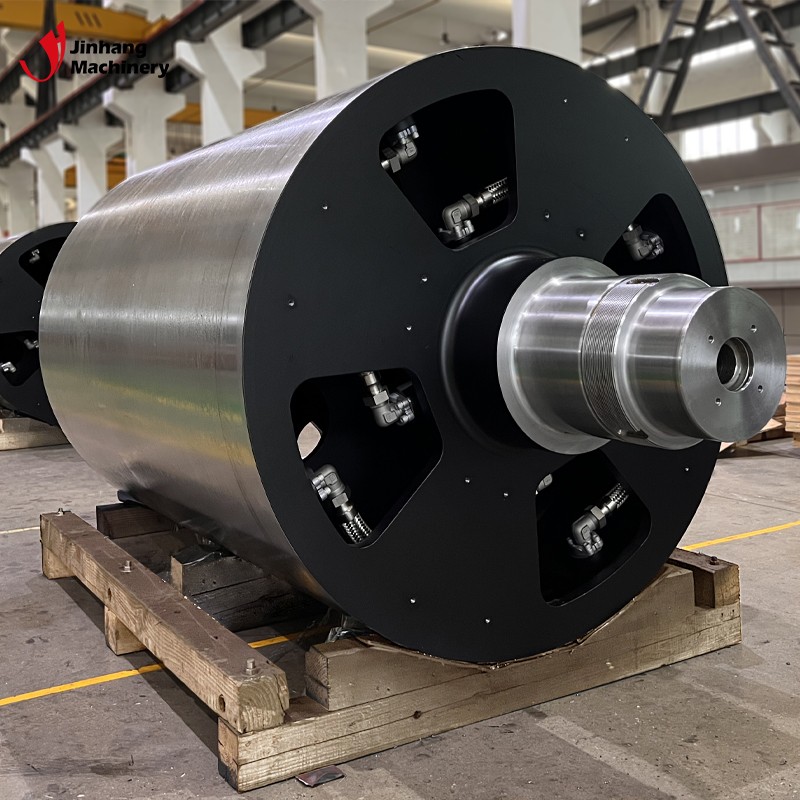
Thermal Oil Heating Rollers: A Proven Solution for Continuous Medium-to-High-Temperature Production
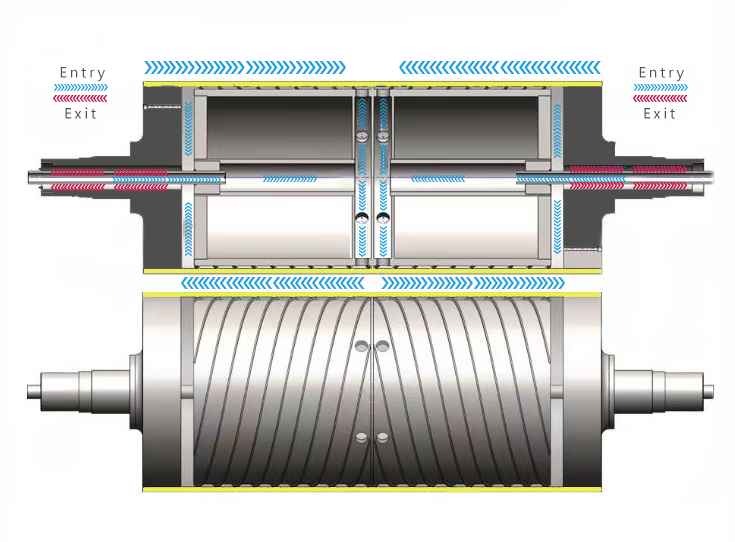
Thermal oil is a common heat transfer medium used in industrial heating rollers. The basic principle involves heating the thermal oil using a thermal oil furnace or a temperature control unit, then using a circulation pump to transport the high-temperature oil into the internal flow channels of the roller. After exchanging heat with the roller body, the oil returns to the heating system to be reheated.
The primary advantage of this method is the continuous circulation of heat.
During production, industrial heating rollers constantly transfer heat to the material, causing the roller surface temperature to drop as the material absorbs heat. The thermal oil circulation system continuously replenishes heat to the roller body, ensuring excellent thermal stability during continuous operation.
In certain engineering applications, well-designed thermal oil heating rollers can limit surface temperature variation to approximately ±3°C to ±5°C. Temperature uniformity can be further improved by employing multi-circuit flow channels, optimizing inlet and outlet positions, and utilizing multi-point temperature monitoring.
However, the stability of a thermal oil heating roller depends on more than just the oil itself; poor internal flow channel design is a common issue. For instance, if the oil enters at one end and exits at the other, the oil temperature gradually decreases as heat is released, potentially leading to temperature differences between the two ends or along the axial length of the roller.
Furthermore, prolonged exposure to high-temperature circulation environments can cause the thermal oil to oxidize, age, and form coke deposits. A decline in oil quality compromises heat exchange efficiency. Consequently, thermal oil heating rollers require regular inspections of the oil condition, circulation pressure, flow rate, and the temperature difference between the inlet and outlet.
Resistance Heating Rollers: Simple Structure, Yet Demanding Regarding Heat Source Layout
Resistance heating is another common method used for industrial heating rollers. Electric heating tubes, rods, or resistance wires are installed directly inside the roller body; electrical energy is converted into heat, which is then conducted to the surface through the metal roller body.
The advantages are clear: the equipment structure is relatively simple, no heat-transfer oil circulation system is required, and startup and maintenance are convenient, making it suitable for many standard industrial heating applications.
However, resistance-heated rollers face a common issue: uneven heat source distribution.
Electric heating elements act as discrete heat sources; the temperature rises first near the element and then conducts outward through the roller body. If the spacing between heat sources is too wide, a pattern of "high temperatures near the heat sources and low temperatures between them" tends to emerge.
Consequently, the temperature uniformity of a resistance-heated roller depends heavily on the number and layout of the heating elements, as well as the roller body material and wall thickness. Standard roller designs may exhibit surface temperature variations of ±8°C or more, whereas optimized multi-zone heating structures can significantly improve uniformity.
This highlights an often-overlooked point: PID control alone cannot resolve all instances of temperature unevenness.
If a sensor monitors only a single location, even if the control system maintains that specific spot precisely at 180°C, it does not guarantee that the entire surface of the industrial heating roller is at 180°C. Therefore, high-precision resistance-heated rollers typically require multi-point temperature sensing and zoned temperature control.
Steam-Heated Rollers: High Heat Transfer Efficiency, but Limited by Operating Pressure
Steam is another well-established heat transfer medium in industrial production. High-temperature steam enters the roller, condenses, and transfers heat to the roller body by releasing latent heat.
The advantage of steam heating is its high heat transfer efficiency; furthermore, steam systems are already widely used in industries such as papermaking, textiles, printing, and drying. If a factory already possesses a robust steam supply system, adopting steam-heated rollers can reduce certain auxiliary equipment costs.
However, steam temperature is directly linked to pressure. Since the boiling point of water at atmospheric pressure is approximately 100°C, achieving higher operating temperatures requires increasing the steam pressure, which in turn imposes stricter requirements on equipment safety and piping systems.
Additionally, steam-heated rollers require solutions for managing condensate discharge, residual air, and pressure fluctuations. Poor control in these areas can lead to unstable roller surface temperatures. Therefore, steam is better suited for low-to-medium temperature processes and facilities that already possess steam infrastructure; however, for industrial heating rollers requiring temperatures of 250°C, 300°C, or higher, thermal oil and electric heating solutions generally offer greater flexibility.
Hot Water Heating Rollers: Suitable for Low-to-Medium Temperature Processes
Hot water possesses a high specific heat capacity, allowing it to provide stable heat output in low-to-medium temperature industrial heating applications.
For processes operating between 60°C and 120°C—or even slightly higher—hot water circulation heating offers the advantages of minimal temperature fluctuation and high safety. Hot water heating rollers are commonly used in sectors such as plastics, textiles, lamination, and drying.
However, the temperature limit of water acts as a significant constraint. If an industrial heating roller must operate continuously at temperatures above 150°C or 200°C, a standard hot water system would require pressurization to raise the operating temperature, thereby increasing system complexity and cost.
Consequently, hot water is not the mainstream solution for medium-to-high temperature industrial heating rollers; instead, it holds a distinct advantage in the low-to-medium temperature range.
Electromagnetic Induction Heating Rollers: A New Direction for High-Precision Temperature Control
In recent years, electromagnetic induction heating has seen increasing application in high-precision industrial heating rollers.
Unlike traditional thermal oil or resistance heating methods—which heat a medium first, which then transfers heat to the roller body—electromagnetic induction utilizes an alternating magnetic field to generate eddy currents directly within the metal roller body, causing it to heat up internally.
This method eliminates intermediate heat transfer stages, resulting in advantages such as rapid response times, higher thermal efficiency, and the ability to implement zoned temperature control.
According to published data, optimized electromagnetic induction heating rollers can achieve surface temperature uniformity within approximately ±1°C, with some units capable of heating from ambient temperature to 200°C in about 20 minutes. However, not all equipment achieves these specific parameters; actual performance depends on factors such as roller diameter, wall thickness, material composition, induction coil configuration, and power output.
For enterprises requiring rapid heating, frequent product changeovers, or variable production speeds, the dynamic response capabilities of electromagnetic induction heating rollers are particularly valuable.
For instance, if an industrial heating roller is operating at 200°C and the production line suddenly accelerates, the material absorbs more heat per unit of time, causing the roller surface temperature to drop. In this scenario, the control system can rapidly increase induction power to replenish heat to the roller body, thereby shortening the recovery time.
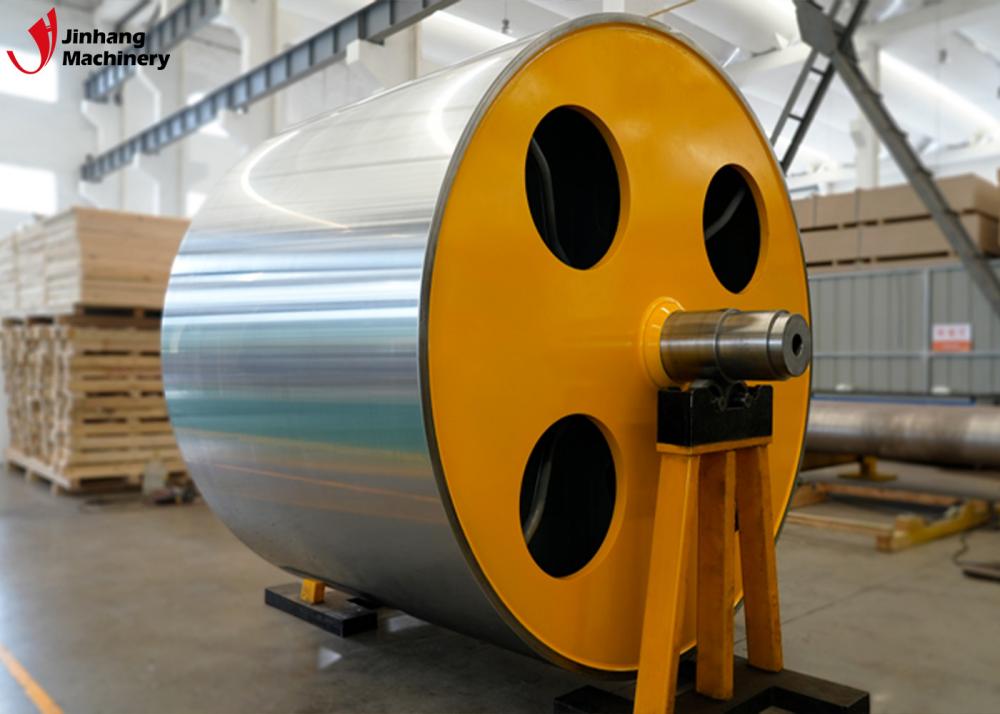
How should one choose an industrial heating roller based on the heating medium?
Practical application considerations allow for the following general assessments:
Thermal oil heating rollers are well-suited for continuous production at medium-to-high temperatures. Their advantages include mature technology, high thermal capacity, and stable heat circulation, making them ideal for production lines requiring consistent, uniform heating.
Resistance heating rollers are suitable for cost-sensitive applications with relatively simple structures, though the layout of the electric heating elements requires careful attention. If strict temperature uniformity is required, multi-zone heating and multi-point temperature monitoring should be considered.
Steam heating rollers are suitable for factories with existing steam systems and for medium-to-low temperature production; while they offer strong heat transfer capabilities, their operating temperature range is limited by steam pressure.
Hot water heating rollers are best suited for medium-to-low temperature processes; they offer operational safety and good thermal buffering capacity but are unsuitable for high-temperature production scenarios.
Electromagnetic induction heating rollers are ideal for production lines requiring high speeds, high precision, and rapid dynamic response—particularly for applications such as precision coating, film processing, lithium-battery materials, and composites.
Therefore, if asked which heating medium offers the best temperature stability, a more accurate answer is: for continuous production at medium-to-high temperatures, a well-designed thermal oil heating roller typically offers superior overall stability; conversely, for high-precision and rapid-response applications, electromagnetic induction heating rollers hold a distinct advantage.
Unstable heating roller temperatures? The problem may not lie with the "medium"
In actual production, temperature instability in a heating roller does not necessarily mean the heating medium needs to be changed. Many issues actually stem from the structural design of the roller itself.
First is the flow channel design. If the internal flow channels of a thermal oil heating roller are too simple, axial temperature differences are likely to occur. Second is the roller wall thickness; excessive thickness delays heat transfer from the interior to the surface, thereby affecting dynamic response.
Third is heat dissipation at the ends. Heating rollers connect to the equipment via shafts, bearings, and other components, creating paths for heat loss; consequently, long industrial heating rollers are particularly prone to the issue of higher temperatures in the center and lower temperatures at the ends.
Fourth is the sensor. Single-point temperature measurement cannot fully represent the temperature across the entire roller surface; for high-precision applications, multi-point measurement or infrared thermography is recommended to verify the actual surface temperature.
The fifth factor is production load. Changes in production speed, material thickness, or material moisture content will alter the thermal load on the industrial heating roller. If the heating power lacks sufficient margin, temperature drops and slow recovery times are likely to occur.
Therefore, addressing temperature control issues in industrial heating rollers requires a comprehensive analysis across six aspects: the heating medium, flow channels, heat source, roller body, sensors, and the control system.
FAQ: Common Questions About Industrial Heating Rollers
Q1: Are thermal oil heating rollers necessarily more stable than electric heating rollers?
Not necessarily. Thermal oil offers excellent heat transfer capabilities and typically performs stably during continuous medium-to-high-temperature production; however, ultimate temperature uniformity also depends on flow channel design, circulation flow rate, and the control system. Well-designed electric heating rollers can also achieve high temperature control precision.
Q2: What is considered a reasonable temperature difference across the surface of an industrial heating roller?
This depends on the production process. Standard industrial heating processes may accept a temperature variance of ±3°C to ±5°C; however, applications such as precision coating, film production, and lithium-ion battery materials demand higher temperature uniformity, with some high-precision rollers capable of limiting the variance to around ±1°C.
Q3: Why is the temperature at the ends of the industrial heating roller lower than in the middle?
This is primarily due to heat dissipation at the ends and the distribution of internal heat flow. The ends of the roller are usually connected to shafts and bearing structures, allowing heat to conduct outward more easily. Additionally, poor flow channel design (for thermal oil) or uneven layout of heating elements (for electric rollers) can cause significant axial temperature differences.
Q4: Which industries are suitable for electromagnetic induction industrial heating rollers?
They are well-suited for production lines requiring high temperature uniformity and rapid response times, such as precision coating, film production, lithium-ion battery materials, composite materials, printing, and certain high-speed heat treatment processes.
Q5: What parameters are most important when selecting an industrial heating roller?
It is recommended to focus on operating temperature, roller surface temperature uniformity, temperature control precision, heat-up time, recovery time following load changes, heating power, and long-term operational stability. For high-precision applications, attention should also be paid to the number of temperature measurement points, zonal temperature control capabilities, and actual load test data.