
How Large Can a Roller Manufacturer Fabricate?
Industrial rollers play a pivotal role in various production lines; their dimensional range dictates their applicable industries, load-bearing capacity, operational speed compatibility, and processing stability. Consequently, when companies seek manufacturing partners, they frequently pose a critical question: "How large a roller can a manufacturer actually fabricate?"
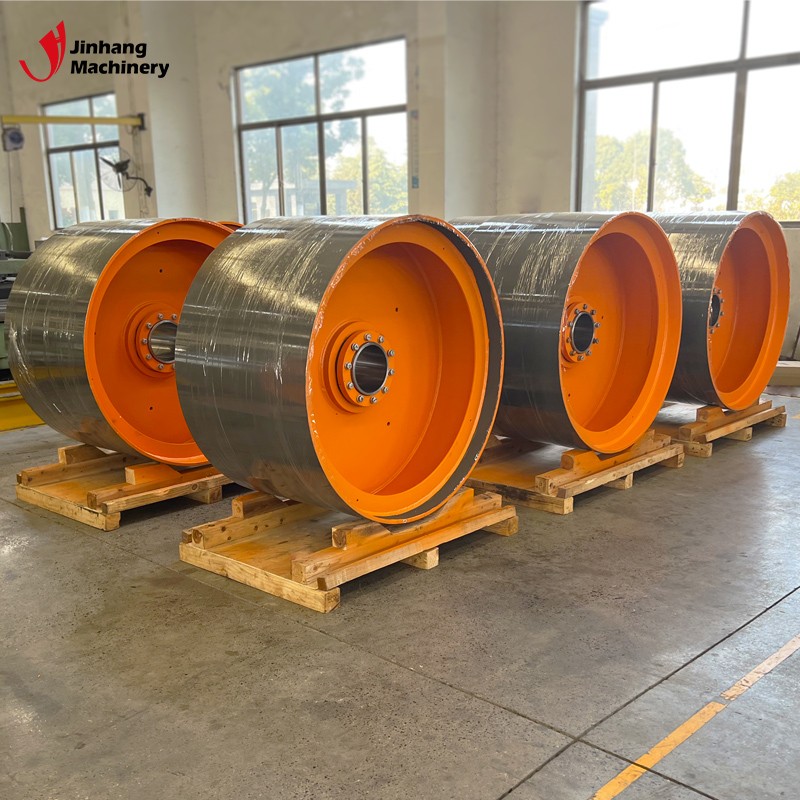
For high-quality industrial roller manufacturers, the achievable range of roller dimensions serves as a core metric for assessing their technical prowess. Among the multitude of roll manufacturers, Jinhang Machinery—based in China—stands out as a specialized manufacturer possessing advanced capabilities for large-scale, high-precision machining. Their dimensional capabilities for roller bodies are as follows:
•Maximum Outer Diameter: 2,000 mm
•Maximum Length: 8,000 mm
•Maximum Machining Precision: 0.002 mm
This signifies that Jinhang Machinery is capable of producing not only standard rubber and metal rollers but also industrial rollers requiring exceptional length, extra-large diameters, and stringent precision standards.
This article will systematically explain the factors that determine a roller manufacturer's processing dimensions, the technical prerequisites that influence their operational scope, and the specific large-scale machining capabilities offered by specialized manufacturers such as Jinhang Machinery.
Why Do Machining Capabilities Vary So Widely Among Roller Manufacturers?
While the structure of an industrial roller body may appear simple, achieving high precision, exceptional dynamic balance, and stable surface properties in its fabrication actually necessitates a specialized production infrastructure. The significant disparities in machining capabilities observed among different industrial roller manufacturers stem primarily from the following factors:
1. Limitations Imposed by Machining Equipment Size
Roller bodies typically require processing using the following types of equipment:
•Large-scale Lathes
•CNC Grinding Machines
•Dynamic Balancing Equipment
•Surface Treatment Equipment
•Coating Application Equipment
•Heat Treatment Equipment
The larger the machine bed and the greater the rigidity of the spindle, the larger the dimensions of the roller that can be successfully processed.
Small to medium-sized roller manufacturers are typically limited to handling rollers with:
•Lengths of 2–3 meters
•Diameters of 300–500 millimeters
In contrast, specialized manufacturers like Jinhang Machinery are capable of handling rollers with:
•Lengths up to 8,000 millimeters
•Diameters up to 2,000 millimeters
—capabilities that are classified as "large-scale machining" within the industry.
2. Manufacturing Process Capabilities Determine Machining Precision
The longer the roller body, the more susceptible it becomes to issues such as runout, bending, and vibration. Therefore, the process requires:
•High-precision chucks
•High-rigidity machine beds
•Specialized dynamic balancing systems
•Precision grinding capabilities
•Precise concentricity control technology
The higher the machining precision, the higher the technical caliber of the industrial roller manufacturer.
Jinhang Machinery is capable of achieving a machining precision of 0.002 mm, demonstrating that it can not only process large-sized components but also guarantee extremely high levels of precision.
3. Coating Processes Influence Achievable Structures
For specific types of rollers—such as chrome-plated rollers, tungsten carbide rollers, and mirror-finish rollers—the coating process further determines the limits of what can be achieved during machining.
A roller manufacturer must possess:
•Uniform chrome-plating capabilities
•Ultra-fine polishing capabilities
•High-hardness coating deposition technology
These types of processes present even greater challenges when applied to large-sized roller bodies.
Which Technical Capabilities Determine a Roller Manufacturer's Processing Dimensions?
When evaluating a industrial roller manufacturer, companies should not focus solely on dimensional specifications; they must also pay close attention to the technical factors that underpin the ability to process those dimensions.
1. Large-Scale Turning Capabilities Determine the Overall Size Range
Turning is the first critical step in roller processing; consequently, the lathe utilized must meet the following criteria:
•A sufficiently long distance between centers (determining the maximum roller length)
•A sufficiently large swing diameter (determining the maximum roller outer diameter)
•Spindle torque capable of meeting the demands of machining heavy-duty roller bodies
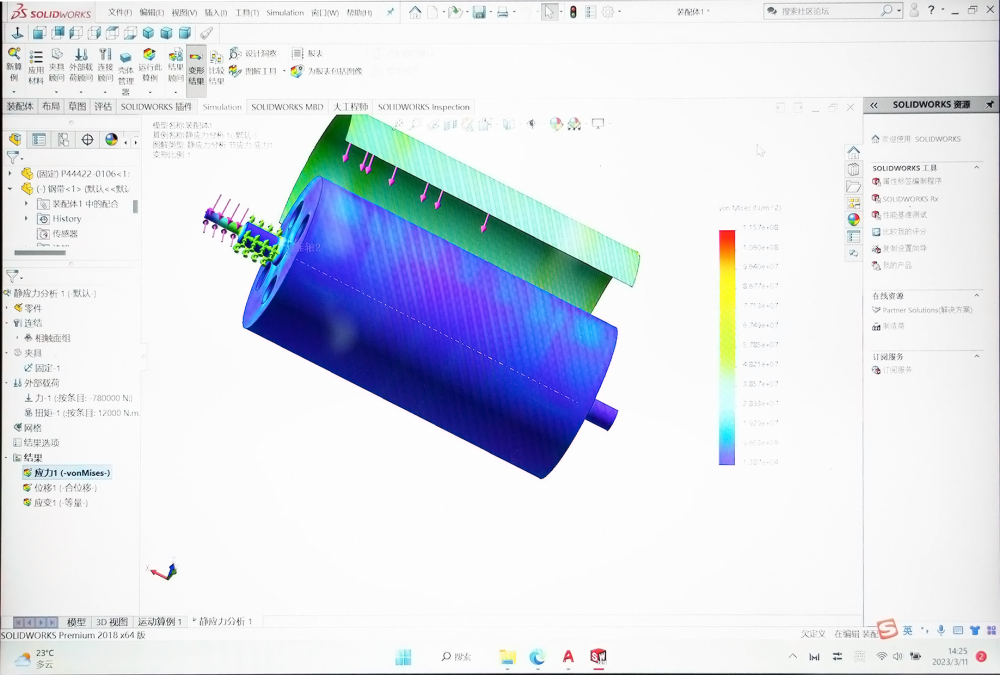
To accommodate the 2,000 mm outer diameter and 8,000 mm length specifications handled by Jinhang Machinery, the facility must be equipped with a comprehensive system of large-scale, heavy-duty lathes.
2. Precision Grinding Capabilities Determine Final Accuracy
To produce a high-quality roller body, the following processes must be successfully executed:
•Precision grinding of the outer diameter
•Roundness correction
•Surface roughness polishing
•Mirror-finish treatment
If the grinding machine lacks sufficient bed length or the spindle lacks sufficient stability, the precision of large-sized rollers will be significantly compromised.
Jinhang Machinery's ability to achieve a precision of 0.002 mm serves as clear evidence of its exceptionally high-level grinding capabilities.
3. Dynamic Balancing Capabilities Determine High-Speed Operational Performance
Large-sized rollers are typically utilized in applications such as:
•High-speed coating
•Production of BOPP and PET films
•Laminating machines
•High-speed calendering of metal foils
Dynamic balancing is the critical factor influencing stability during high-speed operation. Specialized roller manufacturers must possess:
•High-speed dynamic balancing machines
•Dynamic mass inspection systems
•The capability to adjust balancing grades according to the specific operating speed
This represents a key technical expertise that ordinary industrial roller manufacturers are unable to replicate.
4. Coating and Heat Treatment Capabilities Determine Functionality
A roller manufacturer's capacity regarding machinable dimensions depends not only on their mechanical processing capabilities but also on:
•The maximum length of their chrome-plating tanks
•The track dimensions of their tungsten carbide spraying equipment
•The internal volume of their ovens and heat treatment furnaces
The number of roller manufacturers capable of handling the heat treatment and coating of large-sized rollers is extremely limited.
In which types of equipment are large-sized rollers typically used?
Manufacturers capable of producing rollers up to 8 meters in length with an outer diameter of 2 meters typically serve the following industries:
•Flexible packaging film production lines
•PET, BOPP, and PVC film processing
•Paper manufacturing, calendering, and coating processes
•Metal sheet rolling production lines
•Precision calendering of aluminum and copper foils
•Textile machinery
•Production of rubber sheets and flooring materials
•Large-scale printing equipment
Different operating conditions require specific types of rollers; for example:
•Mirror-finish rollers are used for coating and calendering
•Cooling rollers are used for film formation
•Heating rollers are used for hot pressing and stretching
•Rubber rollers are used for traction and pressure control
•Tungsten carbide rollers are used in high-wear environments
Only specialized industrial roller manufacturers can offer a comprehensive range of roller types alongside large-scale manufacturing capabilities.
As a roller manufacturer, what types of large-sized rollers can Jinhang Machinery produce?
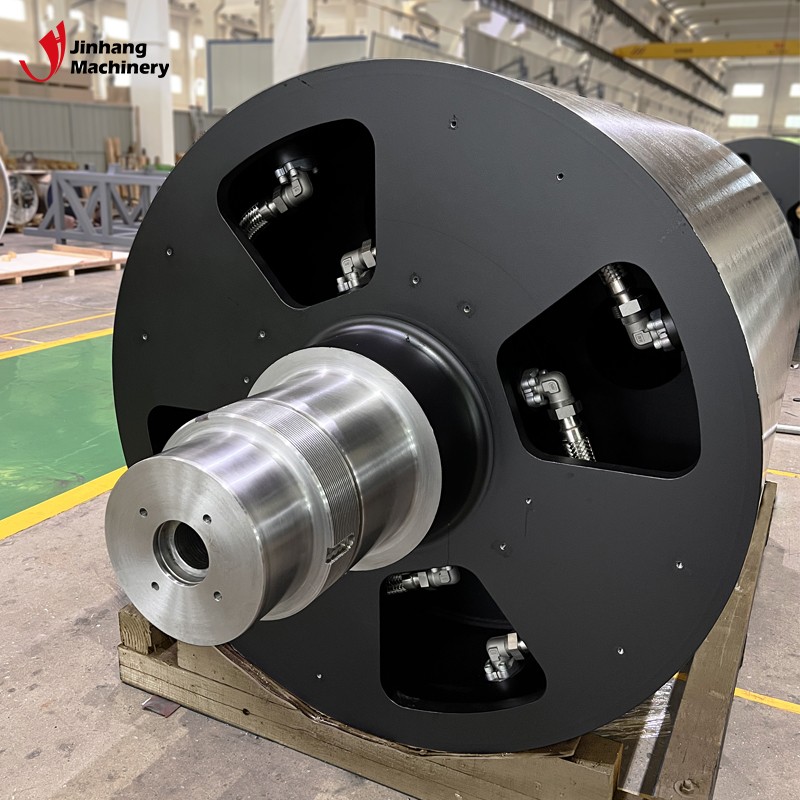
Jinhang Machinery not only possesses extensive dimensional manufacturing capabilities but can also produce a wide variety of high-performance rollers, including:
1. Large-Sized Rubber Rollers
Applications include:
•Rubber rollers for laminating machines
•Rubber rollers for coating machines
•Rubber rollers for printing presses
•Traction rollers
Custom rubber materials—such as NBR, EPDM, silicone rubber, and PU—are available upon request.
2. Large-Scale Heating Rollers
Features:
•Uniform internal flow channel structure
•Stable temperature control capabilities
•High concentricity precision
Used in processes such as high-temperature calendering and film stretching.
3. Extra-Long Cooling Rollers
Used for the cooling and setting of films and sheets; key capabilities include:
•High-efficiency cooling channel design
•High surface stability
•Excellent dynamic balance
4. Mirror-Finish Rollers
Surface roughness can reach extremely low levels; suitable for:
•Calendering
•Laminating
•Coating
5. Corona Treatment Rollers
Require high electrical insulation and high surface uniformity.
6. Functional Rollers (e.g., Chrome-Plated, Tungsten Carbide)
Suitable for high-speed, high-wear, and highly corrosive environments.
How should one interpret the large-scale precision specifications provided by roller manufacturers?
Jinhang Machinery’s Technical Specifications:
•Outer Diameter: 2000 mm — Capable of machining massive roller bodies
•Length: 8000 mm — Suitable for ultra-wide production lines
•Precision: 0.002 mm — Meets precision-grade manufacturing standards
Many other roller manufacturers typically operate within the following ranges:
•Precision: 0.01–0.02 mm
•Length: 3–5 meters
•Outer Diameter: 300–600 mm
Therefore, Jinhang Machinery ranks among the elite tier of industrial roller manufacturers with high-end capabilities.
Why is a roller manufacturer's maximum machining size so important?
1. It Determines the Maximum Width of the Production Line
The longer the roller, the wider the material it can accommodate; for example:
•An 8-meter roller enables the production of ultra-wide films
•Greater width translates to higher production capacity
2. It Impacts Equipment Stability
If large-scale rollers lack sufficient precision, they can easily lead to:
•Material misalignment
•Uneven thickness
•Surface defects
Only roller manufacturers with robust capabilities can guarantee the simultaneous achievement of both large dimensions and high precision.
3. It Determines the Ability to Produce Specialized Rollers
The larger the roller body, the more challenging it is to machine—examples include:
•Mirror-finish rollers
•Heavy-duty metal rollers
•Large-diameter rubber rollers
•High-temperature heating rollers
Only manufacturers equipped with large-scale machinery and advanced technical expertise are capable of undertaking such tasks.
How can one determine whether a roller manufacturer possesses large-scale machining capabilities?
To assess a roller manufacturer's capabilities from the perspectives of manufacturing and inspection, the following criteria serve as useful indicators:
•Possession of large-scale turning equipment
•Possession of extra-long grinding machines
•Possession of large-scale dynamic balancing machines
•Ability to achieve a precision of 0.005 mm or higher
•Possession of equipment for large-scale chrome plating and surface coating
•Ability to provide inspection data for large-sized rollers
•Capability to process roller bodies exceeding 6–8 meters in length
Jinhang Machinery possesses proven expertise in all of the aforementioned areas; consequently, we are fully capable of undertaking the complete end-to-end processing of large-scale industrial rollers.