
Is a Thicker Coating Always Better for Industrial Rollers?
In modern manufacturing, industrial rollers are among the most crucial and irreplaceable mechanical components on production lines, whether in papermaking, film processing, metallurgy, lithium batteries, or textiles. To improve the wear resistance, surface smoothness, corrosion resistance, and stable operation of industrial rollers, surface treatment coatings have become a key technology.
However, with the increasing variety of coating types and the continuous development of coating processes, many people naturally raise a seemingly reasonable question: Is a thicker surface coating always better for industrial rollers?
While the thickness of the surface coating does affect the performance of industrial rollers, "the thicker the better" is not a correct conclusion. Coating thickness depends on the application scenario, substrate strength, load conditions, operating speed, coefficient of friction, thermal expansion characteristics, and even the structural properties of the coating material itself.
This article will answer this question from a professional perspective, analyzing in depth why coating thickness should not be blindly increased, and helping you understand how to choose the appropriate coating thickness for industrial rollers.
What Performance Affects the Coating Thickness of Industrial Rollers?
Before assessing whether the coating thickness is suitable, it is essential to understand the role of coating thickness on industrial rollers.
Surface coatings on industrial rollers are typically used to:
1. Improve abrasion resistance
2. Enhance surface hardness
3. Prevent corrosion and chemical attack
4. Improve frictional properties or surface tension
5. Enhance high-temperature resistance
6. Reduce surface roughness variations to stabilize production quality
Coating thickness is directly related to these properties. For example:
• Thicker coatings can indeed improve lifespan and abrasion resistance.
• However, excessively thick coatings may lead to decreased coating hardness or internal stress cracking.
Therefore, thicker coatings are not always better; the optimal coating thickness is closely related to the application conditions.
Will a thicker coating cause industrial roller deformation or failure?
This is a question many users easily overlook: a thicker coating means greater internal residual stress, which can cause two types of failure:
1. Industrial roller bending or deformation
Industrial rollers are mostly large in size, such as 100–600 mm in diameter and several meters in length. The thicker the coating, the more pronounced the difference in thermal stress on the substrate, resulting in:
• Slight misalignment of the roller axis
• Deterioration of surface roundness
• Dynamic imbalance
• Increased vibration during operation
For high-speed industrial rollers, this type of deformation can severely impact production line quality.
2. Coating peeling or flaking
The thicker the coating, the more prone it is to:
• Excessive internal stress
• Insufficient adhesion between the coating and the substrate
• Cracks under thermal cycling conditions
• Delamination or peeling due to mechanical impact
This means that thicker coatings are actually more dangerous.
Do different types of industrial rollers have different requirements for coating thickness?
Of course not. Industrial rollers are not a single type of equipment; they encompass various types, commonly including:
• Chrome-plated rollers
• Ceramic-coated rollers
• Aluminized rollers
• Rubber-coated rollers
• Laser cladding rollers
• Thermal spraying rollers (e.g., tungsten carbide-coated rollers)
• Mirror-finish rollers
• Traction rollers, flattening rollers, calendering rollers, coating rollers, etc.
Different industrial rollers operate in different environments, and therefore, their coating thicknesses vary. For example:
• Industrial rollers in high-speed thin-film production lines: Emphasis is placed on dynamic balance, requiring a thin and uniform coating.
• Metallurgical wear-resistant industrial rollers: Thicker wear-resistant coatings are permissible, but stress must be controlled.
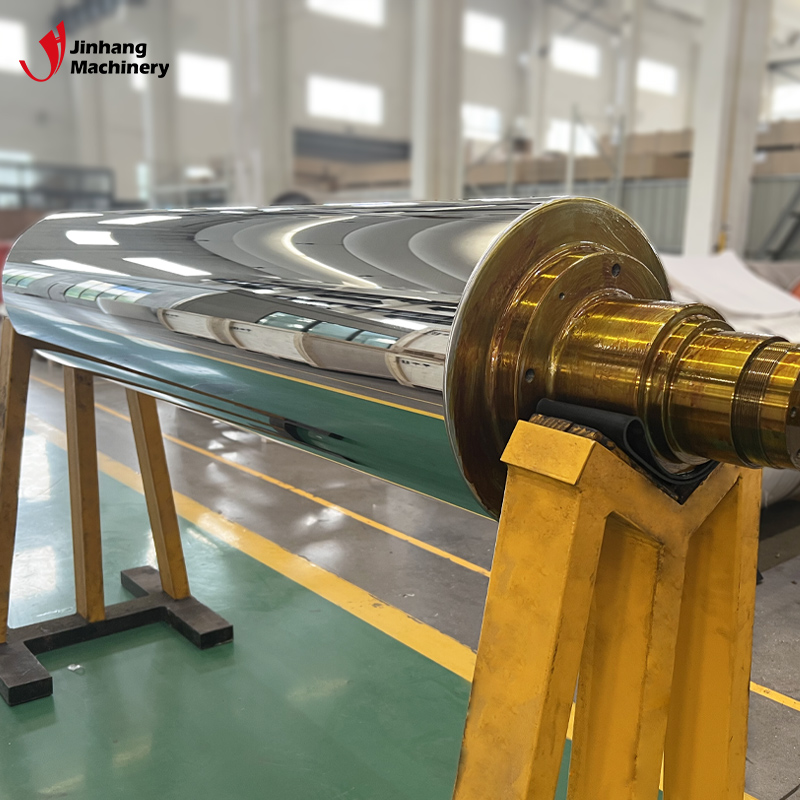
• Mirror-finish industrial rollers: To achieve extremely high surface precision, thicker coatings are actually detrimental to polishing.
Therefore, the notion that "thicker is better" is incorrect.
What are the potential risks of excessively thick coatings on industrial rollers?
The following points are crucial:
1. Increased Residual Stress Within the Coating
When the coating is too thick, the internal tensile stress cannot be released, potentially leading to:
• Cracks
• Peeling
• Localized flaking
• Enlarged micropores on the surface
• Worsened eccentricity
2. Decreased Surface Hardness
When the thickness of some coating materials exceeds the process threshold, the structure becomes loose, resulting in:
• Localized soft spots
• Uneven wear
• Premature failure
3. Increased Oxidation and Porosity (Thermal Spraying)
When the thickness of a thermal spray coating exceeds a reasonable range:
• Porosity becomes more difficult to control
• Increased oxidation rate
• Increased density of surface microcracks
This can cause serious problems under high-speed or high-pressure conditions.
4. Deterioration in Processing Accuracy
Thick-coated industrial rollers ultimately require grinding and polishing to achieve the required accuracy. The thicker the coating:
• Greater processing difficulty
• Greater difficulty in maintaining roundness
• Difficulty in achieving the required surface roughness
This means that thicker coatings are not necessarily better.
5. Increased Costs Without Increased Efficiency
Excessively thick coatings can lead to:
• Additional processing costs
• Longer processing cycles
• Higher material costs
• However, the increase in lifespan is not proportional to the increase in lifespan
It can even result in the contradictory effect of "increased costs but decreased lifespan."
How to determine if the coating thickness of current industrial rollers is appropriate?
To determine if a coating is suitable, consider the following aspects:
1. Operating Conditions
Including:
• Operating speed (high speeds are not suitable for thick coatings)
• Operating temperature
• Friction conditions
• Characteristics of contact materials
• Whether it is subject to long-term load
2. Substrate Material Strength
For example:
• High-strength steel rollers can withstand appropriate thicknesses
• Ordinary steel or thin-walled rollers are not suitable for thick coatings
3. Coating Type and Properties
For example:
• Carbide coatings (hard and brittle, not suitable for excessive thickness)
• Ceramic coatings (brittle, not suitable for thick thicknesses)
• Metal spray coatings (can be appropriately thick)
• Coating layers can be several millimeters or even several centimeters
Therefore, "thickness standards" cannot be universally applied.
4. Industry Experience Values
While case studies cannot be cited, there are generally common process ranges within the industry, such as:
• Thermally sprayed ceramic layers are typically 50–300 μm.
• Metal transition coatings can reach 100–500 μm.
• Chrome plating is generally 20–100 μm.
If the coating thickness exceeds the conventional range, the risks must be assessed.
Can industrial rollers have their lifespan extended by thickening the coating?
Many users believe that thicker coatings result in longer lifespans, but this is not technically the case.
The reasons include:
1. Excessive internal stress in the coating → leading to earlier failure
2. The thicker the coating, the more difficult it is to guarantee processing precision
3. Wear resistance decreases instead of increasing after the coating thickness exceeds a certain threshold
4. Decreased coating bonding strength
5. Difficulty in controlling surface roughness
6. Localized wear is more pronounced
Therefore, lifespan is not achieved by "increasing thickness," but rather by:
• Suitable coating type
• Correct thickness
• Scientific processing technology
• Good substrate material
• Precise surface precision
Only "reasonable thickness" can truly extend lifespan, not simply "increasing thickness."