What is the heating medium of industrial heated rollers?
In modern industrial heat treatment equipment, "heated rollers" are key components that ensure materials are uniformly heated, shaped, calendered, or cured. Their internal heating method directly affects heating efficiency, temperature stability, product quality, and production continuity.
Therefore, understanding what the heating medium of heated rollers is, why different heating media are chosen, and the conditions under which different media are suitable are essential knowledge points for engineers, equipment manufacturers, and factory technicians.
This blog will start from the working principle of heated rollers and analyze the characteristics of various heating media, including heat transfer oil, electric heating, steam, hot water, molten salt, and special media, to help you fully understand the core question: "What is the heating medium of industrial heated rollers?"
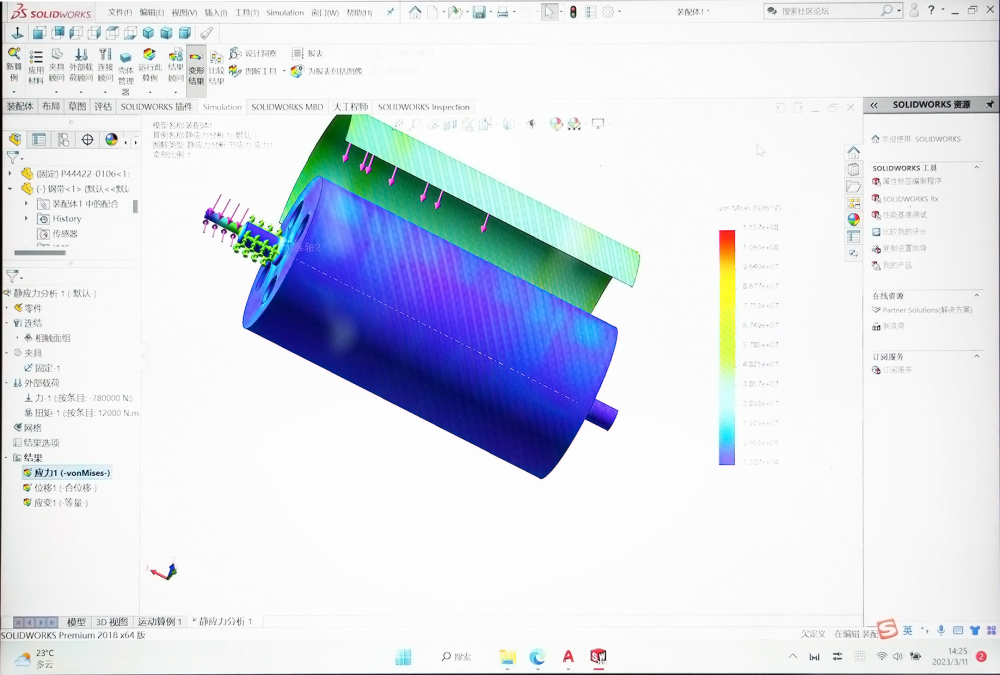
How do heated rollers work?
Heated rollers are essentially industrial rollers that can transfer heat energy internally and evenly to the outer surface. Their core functions include:
• Providing a stable operating temperature
• Maintaining uniform roller surface temperature
• Controlling the heat treatment effect of materials
• Influencing the quality of processes such as calendering, extrusion, coating, and lamination
But how does energy reach the inside of the heated roller? The answer is the heating medium.
The heating medium is a "heat carrier" used to transfer heat energy from the heat source to the entire interior of the heating roller. It determines:
• The maximum temperature the heating roller can reach
• The stability of temperature control accuracy
• The speed of heating
• The uniformity of temperature distribution on the roller surface
• Safety and maintenance costs
Therefore, "What is the heating medium for the heating roller?" is not just a material selection question, but a key technical point affecting the operation of the entire heat processing production line.
Why do industrial heating rollers require different heating media?
Different production processes have different heating requirements. For example:
• Plastic film extrusion and calendering require stable medium to high temperatures
• Coating requires precise temperature control to avoid material decomposition
• Rubber calendering requires high temperatures and uniform heating
• Wood grain embossing requires consistent temperature distribution
• Chemical fiber stretching is extremely sensitive to temperature fluctuations
Therefore, the selection of heating rollers must consider process temperature requirements, heat load, medium stability, and safety.
In short: There is no one-size-fits-all heating medium. Different production purposes require heating rollers with different media.
What are the common heating media used in industrial heated rollers?
Below, we will analyze the main heating media used in heated rollers one by one:
1. Thermal oil (most common)
2. Electric heating (no medium required, self-contained system)
3. Steam
4. Hot water
5. Molten salt heating media
6. Other special media (such as air, gas, heat pipe technology, etc.)
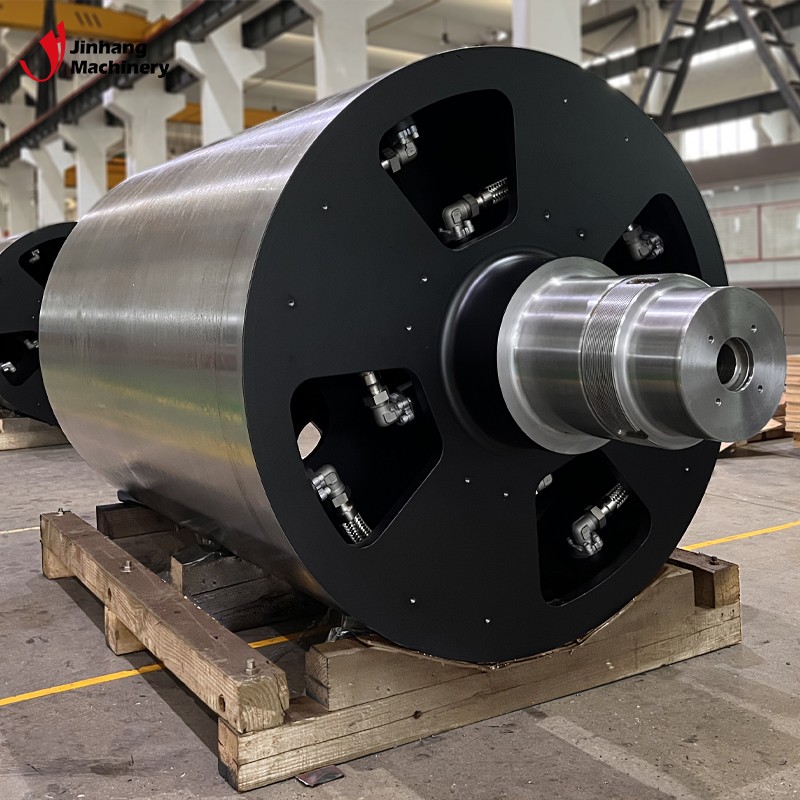
Detailed Explanation of Heating Media: Advantages, Disadvantages, and Applications of Different Media
The following sections focus on key content, providing in-depth analysis through a question-and-answer structure.
1. Why is thermal oil the most commonly used heating medium for heated rollers?
Temperature oil is one of the most widely used media for heated rollers, with significant advantages:
① Wide temperature range
Most thermal oils can operate stably for extended periods between 150°C and 350°C, and some can even reach 400°C (depending on the grade).
② Good temperature stability
Temperature oil has stable flow, making it easy to maintain a temperature control accuracy of ±1°C on the roller surface.
③ Low corrosivity to heating rollers
It does not cause scale or corrosion problems like steam.
④ Uniform heat transfer
The fluidity of the oil allows for more even heat circulation within the roller.
⑤ No high-pressure equipment required
Compared to steam, the heating system pressure is significantly reduced, resulting in higher safety.
Applications of heat transfer oil heated rollers:
• Plastic film extrusion and calendering
• Rubber calendering
• Coating equipment
• Thermosetting of composite material substrates
• Wood grain hot embossing
For industries requiring medium to high temperatures, long-term stable temperature control, and high temperature uniformity, the use of heat transfer oil in heating rollers is almost standard.
2. Why is electric heating suitable for some heating rollers?
Electric heating does not rely on liquids or steam; instead, it directly heats the roller body through built-in heating rods or resistance wires, a "medium-free" method.
Characteristics of electric heating rollers:
① Simple structure and easy maintenance
No need for heating boilers, oil temperature controllers, or steam pipelines.
② Fast Temperature Response
Electric heating has a short heating time, suitable for rapid production changeovers.
③ Extremely High Temperature Control Accuracy
Achievable at ±0.5°C levels via intelligent regulators.
④ Suitable for Medium and Low Temperature Scenarios
Most electric heating rollers are suitable for temperatures around RT–250°C.
Applicable Processes:
• Small coating machines
• Heat transfer printing
• Small laboratory extrusion and calendering equipment
• Preheating of thin materials
If the process temperature does not need to be too high, and convenience and rapid temperature adjustment are emphasized, electric heating rollers are an excellent choice.
3. Why do some heating rollers still use steam as the heating medium?
Steam heating rollers are a traditional but still widely used method.
Advantages of steam as a medium:
① Rapid Heating
Steam has extremely high temperature rise efficiency when releasing latent heat.
② Suitable for low to medium temperature (100–180°C) conditions
For example, many pieces of equipment in the paper industry still use steam rollers.
③ Relatively low cost
Especially when the factory already has a centralized steam boiler system.
Disadvantages of steam-heated rollers:
• Requires a high-pressure container
• Prone to scale buildup
• Poor temperature control accuracy
• Less stable than heat transfer oil in high-temperature range
Typical industries:
• Papermaking
• Textile finishing
• Mild heating and drying
When the factory already has a steam system and the temperature is not high, and cost is a concern, steam will be used as the heating medium for the rollers.
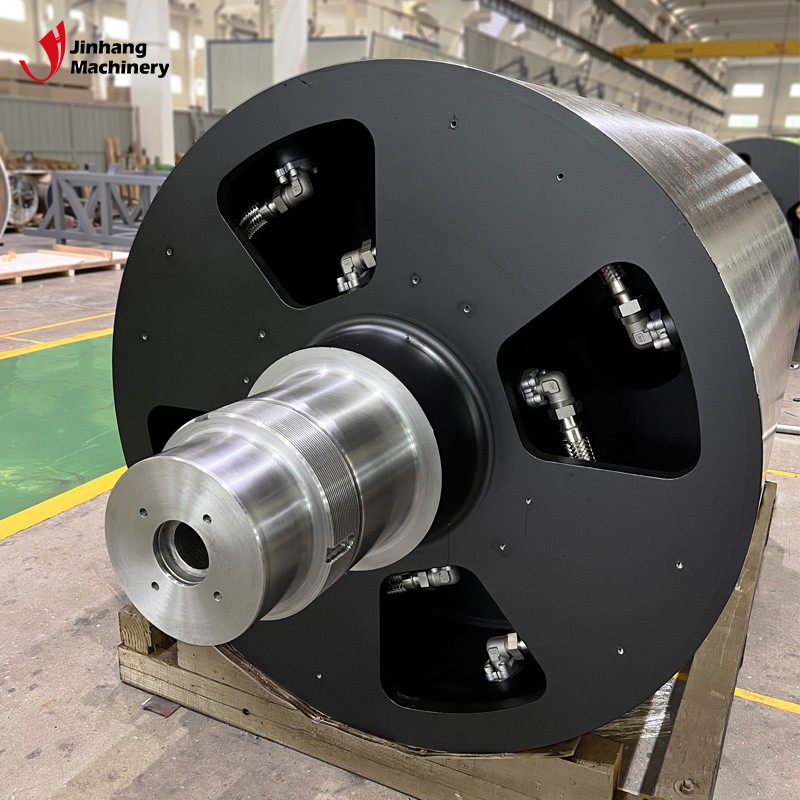
4. What are the advantages of using hot water as the heating medium for rollers?
Hot water provides very stable low-temperature heating, commonly in the range of 50–95°C.
Hot water is suitable for:
① Industries with extremely high requirements for temperature fluctuations
Hot water has a high specific heat capacity, resulting in minimal temperature fluctuations.
② Processes sensitive to material temperature
For example, adhesive coating, food packaging film material processing, etc.
Advantages:
• Very uniform temperature
• High temperature control accuracy
• Good safety
Hot water heating rollers are mainly used in production lines with extremely high requirements for low-temperature stability.
5. Can molten salt be used as a heating medium for heating rollers?
Molten salt is a medium that remains liquid at high temperatures and conducts heat, primarily used in ultra-high temperature applications (350°C–550°C).
Advantages of molten salt heating rollers:
• Can withstand very high process temperatures
• Excellent high-temperature thermal stability
• High heat transfer efficiency
Disadvantages:
• High cost
• Complex system
• High maintenance requirements
• Not suitable for ordinary factories
Molten salt heating rollers are only used in a very limited number of ultra-high temperature industrial production lines.
6. Are there other special heating media?
There are indeed some special applications:
① High-temperature air heating rollers
Used for non-contact heating in food, paper drying, etc.
② Heat pipe heating rollers
Utilize gas-liquid phase change for heat transfer, suitable for processes requiring extremely high temperature uniformity.
③ Inert gas media
Used in certain special production lines where oxidation of materials is not permitted.
Although uncommon, these are still part of the heating media used in heating rollers.
How to Choose the Right Heating Medium for Heating Rollers?
The following key factors should be considered when selecting a heating medium:
1. What is the heating temperature?
Temperature Range | Recommended Medium
30–95°C | Hot Water
100–180°C | Steam or Thermal Oil
150–350°C | Thermal Oil (Most Commonly Used)
350–550°C | Molten Salt
<250°C | Electric Heating
2. Is high temperature uniformity required?
• Extremely high → Hot Water, Electric Heating, Thermal Oil
• Medium → Steam
• High Temperature → Thermal Oil or Molten Salt
3. What is the existing energy system of the plant?
• Boiler present → Steam or Hot Water commonly used
• No Boiler present → Electric Heating or Thermal Oil is more suitable
4. Does the process allow for a complex heating system?
• Flexibility and convenience required → Electric Heating
• Long-term stable production required → Thermal Oil
5. What about cost?
• Electric heating has low initial cost, but high long-term electricity bills.
• Thermal oil systems have moderate equipment costs, but stable operation.
• Steam has low costs but high maintenance costs.
• Molten salt systems are high-cost systems.
The Influence of Different Heating Media on Heated Roller Performance
Different heating media affect the following characteristics of the heated roller:
• Temperature control accuracy
• Temperature uniformity
• Heating rate
• Safety
• System complexity
• Maintenance difficulty
• Roller surface quality stability
Among these, temperature uniformity is particularly important for processes such as calendering, lamination, and coating. Therefore, thermal oil and electric heating are becoming increasingly popular in modern equipment.