Industrial Heated Rollers: Who Needs Oil or Water Guiding?
In modern industrial processing, heating systems often directly determine production efficiency, product quality, and equipment stability.
As one of the most critical heat transfer components, "heated rollers" play an irreplaceable role in industries such as film production, papermaking, rubber calendering, metal foil processing, textile drying, and composite material processing.
However, many companies often struggle to determine the best choice between "oil-guiding heated rollers" and "water-guiding heated rollers":
When should oil-guiding heated rollers be chosen? Which industries or processes are more suitable for water-guiding heated rollers? What are the differences between the two?
This requires a systematic analysis from multiple perspectives, including temperature requirements, stability requirements, material properties, thermal uniformity, energy consumption characteristics, and operational safety.
This article will provide an in-depth professional analysis of industrial heated rollers, specifically which require oil guiding and which require water guiding, helping you make the most suitable choice for your process needs.
Why is it necessary to distinguish between oil-guiding and water-guiding industrial heated rollers?
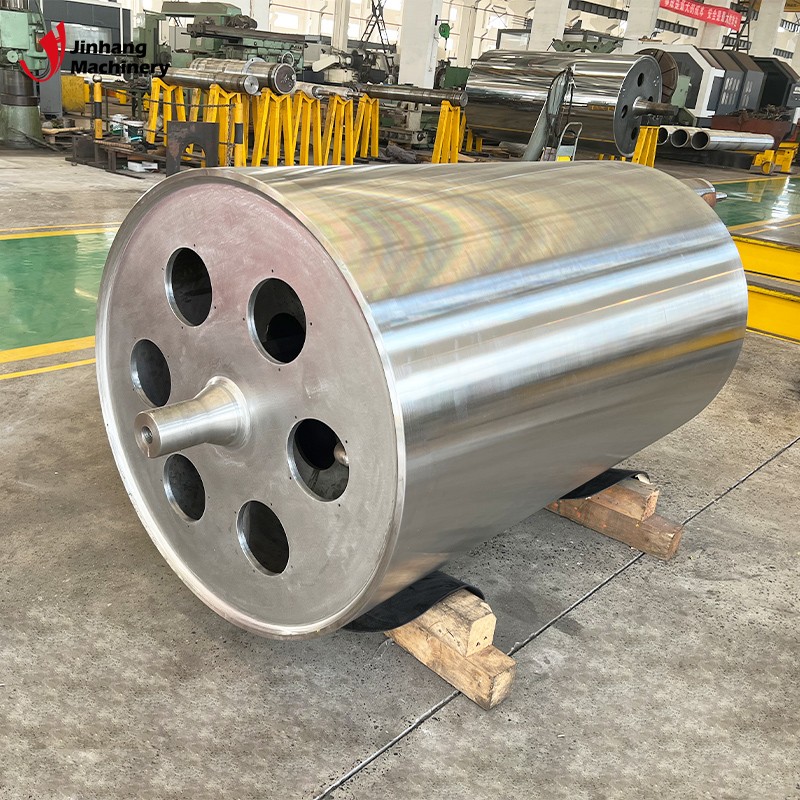
The task of a heating roller is very clear: to uniformly transfer heat to the roller surface and ultimately, stably, to the material through a circulating heating medium within the roller body.
The difference in the heating medium directly determines:
• The maximum temperature the heating roller can reach
• The stability of temperature changes
• Heating speed
• Energy consumption
• Safety performance
• The structural form of the heating roller
• Suitable industries and material types
Oil-guiding heating rollers and water-guiding heating rollers are not in competition, but rather two types of industrial heating rollers perfectly suited for different temperature ranges, different process characteristics, and different production goals.
Therefore, correctly selecting the heating roller medium in an industrial setting is a decision with significant economic and technical value.
What are the essential differences in the working principles of oil-guiding heating rollers and water-guiding heating rollers?
To better determine which should be used for oil and which for water, we must understand their fundamental differences.
✔ Oil-Conducting Heated Roller (Heat Transfer Oil Circulation System)
• Uses heat transfer oil as the heat medium
• Common temperature range: 120℃~350℃ and above
• Uses a hot oil generator to provide heat
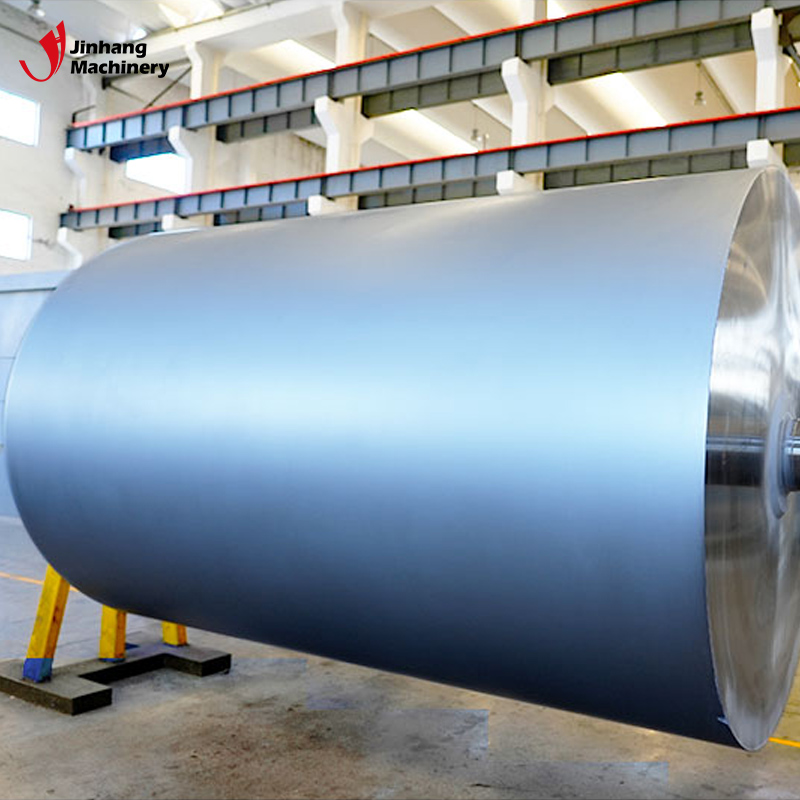
• The roller body structure has an internal spiral oil passage
• Belongs to the high-temperature heating roller category
The key characteristics of heat transfer oil are "high boiling point", "no phase change", and "high heat capacity", making it suitable for high-temperature and high-stability applications.
✔ Water-Conducting Heated Roller (Water Circulation Heating System)
• Uses water as the heat transfer medium
• Common temperature range: room temperature~90℃
• Relies on circulating water or steam heat exchangers for heating
• Suitable for medium and low temperature processes
• The roller body often uses a straight-through or simple water passage structure
• Belongs to the low-temperature heating roller category
Water has advantages such as high specific heat capacity, good fluidity, and low cost, but its temperature is limited by its boiling point, making it more suitable for low-temperature processing.
So—who needs oil-conducting rollers? Who needs water-conducting rollers?
The following is a breakdown from an industrial perspective.
Which industries require the use of oil-guided heating rollers?
To meet the requirements of high-temperature processing, stable heat treatment, and precise temperature control, the following conditions are all significantly favorable for oil-guided heating rollers.
Why are oil-guided heating rollers essential for high-temperature processes?
This is one of the core advantages of oil-guided heating rollers.
The heat transfer oil can stably support high temperatures of 150℃~350℃, far exceeding the boiling point limit of water.
Therefore, the following industries almost universally require oil-guided heated rollers:
• Electronic functional film production
• PET/PVC/PP film stretching processes
• Rubber calendering heating
• Artificial leather, coating thermosetting
• High-temperature lamination of composite materials
• Heat treatment of metal foil materials
• Lithium battery separator heat setting
• Hot melt adhesive, hot pressing equipment
• High-temperature embossing, heat setting rollers
These processes require the following from heated rollers:
• High temperature
• Stability
• Uniformity
• No fluctuations
• Controllable heating and cooling
Water is completely insufficient for stable operation above 100℃, therefore oil-guided heated rollers have become standard equipment in high-temperature industrial applications.
Why are oil-guided heated rollers more suitable for processes with extremely high requirements for temperature uniformity?
The uniformity of the heating roller surface temperature is one of the most important indicators in industrial processing.
Temperature differences can lead to:
• Uneven material thickness
• Inconsistent surface gloss
• Changes in mechanical properties
• Uneven stress distribution
• Shrinkage deformation
The reason why oil-guided heated rollers can achieve high uniformity is because:
• The heat transfer oil does not undergo a phase change (unlike water, which easily vaporizes)
• Stable flow, without periodic fluctuations
• High heat capacity, maintaining temperature balance
• The spiral oil path design allows the heat medium to fully cover the roller body
Therefore, oil-guided heated rollers must be selected for the following applications:
• High-optical-grade film production
• Thermosetting sections of coating equipment
• High-end calendering equipment
• Composite materials sensitive to temperature fluctuations
• Hot pressing processes requiring precise temperature control
These processing techniques have extremely low tolerance for temperature differences, generally requiring control within ±1~2℃, which is difficult for water-guided heated rollers to achieve.
Why do long-cycle continuous production lines prefer oil-guided heated rollers?
If the process requires stable operation for 24 hours, then oil-guided heated rollers offer the following advantages:
• No scale buildup in the hot oil system
• No steam condensation interference
• Stable temperature over long periods
• No thermal shock
• Less impact on structure from pressure
Water often experiences the following problems during long-term operation:
• Scale accumulation
• Temperature fluctuations
• Roller fatigue caused by thermal changes
• Pipeline corrosion
• Instability due to pressure changes
Therefore, oil-guided heated rollers are more reliable for high-load equipment.
Why do high-stability and high-safety applications favor oil-guided heated rollers?
While some may think that heat transfer oil sounds more "dangerous" than water, in reality: Oil-guided systems are low-pressure systems, while steam and high-temperature water are high-pressure systems.
The safety advantages of the oil guiding system include:
• Low pressure even at 200–300℃
• No dangerous high-pressure steam generation
• Less corrosion to internal components
• Low thermal shock, less prone to cracking
• No scale buildup, no reduction in thermal efficiency
Therefore:
• High temperature
• High stability
• High safety level
The processing conditions possessed by all three are more suitable for oil guiding heating rollers.
So, which industries are more suitable for water guiding heating rollers?
The following analyzes the characteristics of water guiding heating rollers:
✔ Lower temperature
✔ Lower cost
✔ Simpler structure
✔ Faster heating speed
✔ Convenient control
This allows us to determine its applicable range.
Why do low-temperature processing industries prefer water guiding heating rollers?
The operating temperature range of water guiding heating rollers is mainly between 20℃ and 90℃.
Therefore, all industries that only require medium to low temperature heating are more suitable for using water guiding heating rollers.
Including:
• Drying stages in the paper industry
• Preheating of textiles
• Preheating of adhesive tapes
• Shaping of food and pharmaceutical packaging materials
• Drying stages of low-temperature plastic films
• Low-temperature lamination equipment
These processes have low temperature requirements, making water-guided heating rollers the optimal choice due to their low cost and rapid heating.
Why do cost-sensitive industries prioritize water-guided heating rollers?
The cost advantages of water-guided heating rollers are:
• Water as the heat medium has almost zero cost
• Simple water circulation system structure
• No need for expensive equipment such as oil heaters
• Low maintenance costs
• Low piping requirements
Therefore, if a company does not require high temperatures or high-precision temperature control, water-guided heating rollers are the most economical and rational choice.
Which processes are not sensitive to temperature fluctuations?
Why are they suitable for water-guided heating rollers?
Compared to oil-guiding heated rollers, water-guiding heated rollers exhibit slightly larger temperature fluctuations. However, some processes are not sensitive to this, such as:
• Primary heat treatment of textile materials
• Low-temperature drying of general plastic films
• Drying processes that do not require precise control
• Low-temperature setting of biological materials and food packaging films
• Low-temperature drying of adhesives or coatings
The key factors for these processes are not temperature uniformity, but rather:
• Cost control
• Heating rate
• Auxiliary heating
• Process simplicity
Therefore, water-guiding heated rollers are perfectly adequate.
Who is suitable for oil guiding? Who is suitable for water guiding?
Suitable Scenarios for Oil-Guiding Heated Rollers (High-Temperature Type)
Suitable for:
• High temperature (>120℃)
• High temperature uniformity requirements
• Precise temperature control required
• Extremely sensitive to temperature differences
• Requires long-term stable continuous production
• High safety requirements
Typical industries include:
• High-end optical films
• PET/PP/PVC film stretching
• Rubber calendering
• Hot melt bonding
• High-temperature lamination
• Coating thermosetting
• Hot pressing equipment
• Lithium battery separator production
Suitable Scenarios for Water-Guiding Heated Rollers (Low-Temperature Type)
Suitable for:
• Low temperature (<90℃)
• Low temperature uniformity requirements
• Requires rapid heating and simple structure
• Cost-sensitive
• Stable process but low requirements
Typical industries include:
• Paper drying section
• Textile drying
• Low-temperature drying of food packaging films
• Preheating of adhesive tape materials
• Low-temperature lamination equipment
• General Industrial Drying Processes
If the process requires high temperature, high precision, and high stability, then an oil-guided heating roller must be selected.
If the process requires low temperature, is cost-sensitive, and has lower requirements for thermal stability, then a water-guided heating roller is more suitable.
There is no absolute superiority or inferiority between the two, only the most suitable match.