
What are the uses of industrial cooling rollers?
In many continuous industrial production lines, cooling rollers are crucial temperature control rollers, alongside heating rollers. Unlike heating rollers, which are responsible for raising the temperature, cooling rollers play a vital role in cooling, curing, shaping, stabilizing tension, and controlling material structure. In equipment used in industries such as film manufacturing, coating and laminating, calendering, papermaking, aluminum foil production, rubber and plastics processing, textile printing and dyeing, and lithium battery separators, cooling rollers are almost indispensable key components.
Many people are relatively familiar with the uses of heating rollers, but have less understanding of the actual function, technological significance, and performance requirements of cooling rollers. So, the questions arise:
What are industrial cooling rollers used for? What key functions do they perform in production? Is the role of cooling rollers simply "lowering the temperature"?
This article will delve into this core question from multiple perspectives, including heat transfer theory, material processing requirements, roller structure design, and production line operation logic.
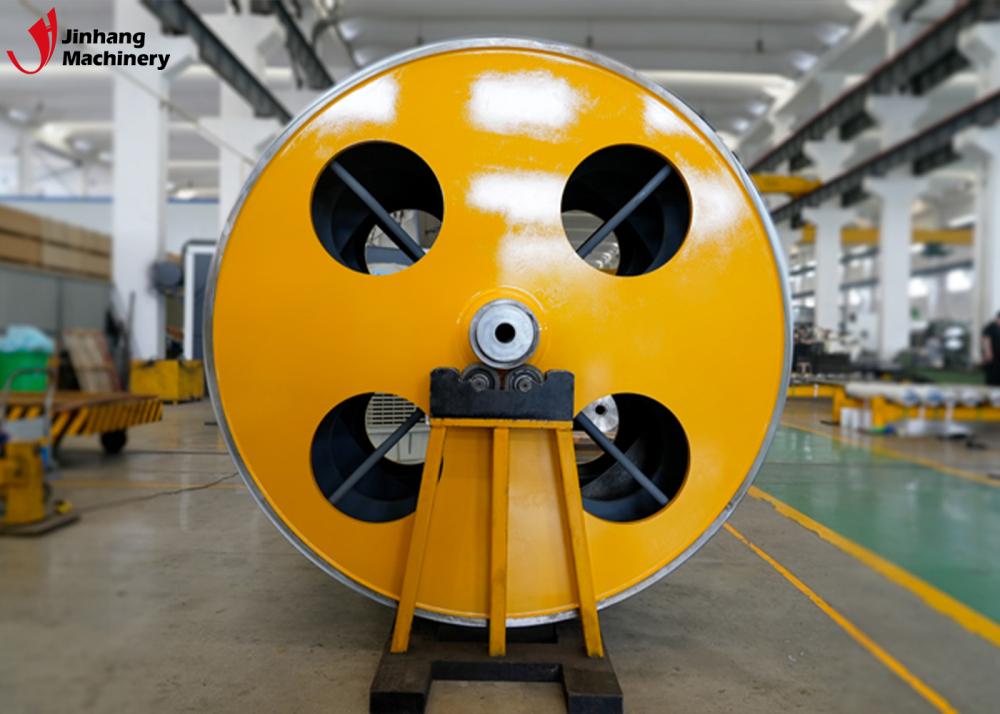
Why are cooling rollers an essential component in continuous industrial processing?
To understand the purpose of cooling rollers, it's essential to understand that a modern industrial production line is a complex thermal process system:
• The initial stage often requires heating, softening, melting, or coating.
• The middle stage requires shaping, flattening, stretching, or curing.
• The final stage must cool, stabilize dimensions, or improve mechanical properties.
Cooling rollers are responsible for the "second half" of the temperature control process, ensuring that the material:
• Transitions from a high-temperature state to a controllable temperature range.
• Stabilizes from a softened state to a solid state.
• Rapidly stabilizes the surface state.
• Achieves uniformity in the internal structure.
• Maintains dimensional stability under tension.
Therefore, it's clear that:
Cooling rollers are not simply "cooling components," but rather a core structure in the material stabilization process.
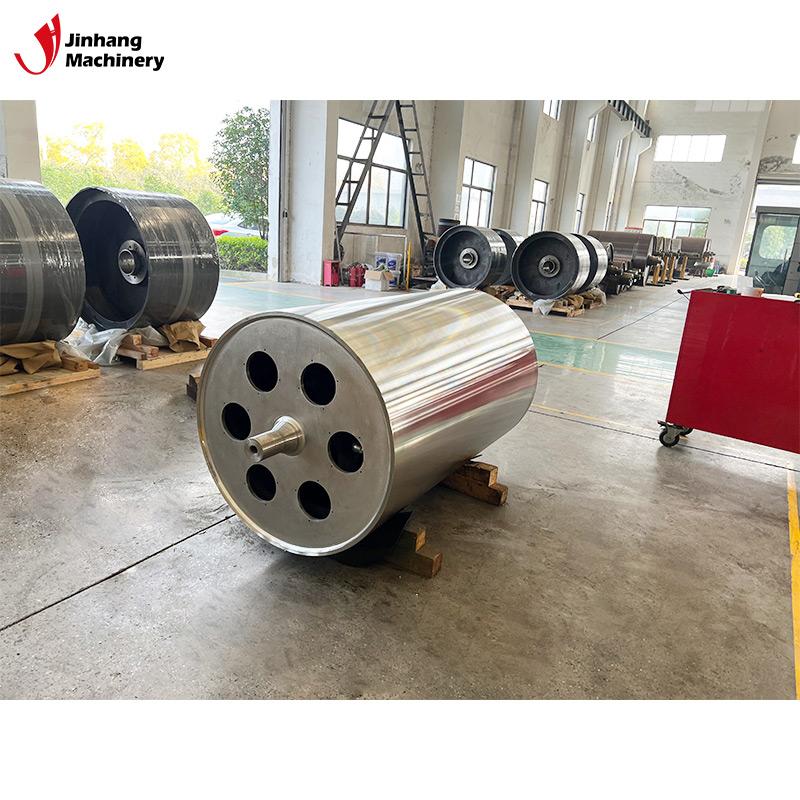
What is the role of cooling rollers in film or sheet production?
Film, sheet, and plate materials are typically in a soft or semi-molten state after processes such as heating, extrusion, coating, and calendering. Without the precise control of cooling rate by cooling rollers, the following cannot be achieved:
• A smooth surface
• Stable thickness
• Uniform molecular structure
• Stable mechanical properties
The main uses of cooling rollers in such processes include:
1. Rapidly removing heat from the material surface for curing
The more uniform the cooling rate, the lower the internal stress of the material, and the better the quality stability.
2. Controlling the final thickness and surface smoothness
The surface precision of the cooling rollers directly affects the calendering effect of the material surface.
3. Stabilizing production line tension to prevent material deformation
High-temperature materials are soft and ductile; their tension only stabilizes after cooling.
Therefore, the role of cooling rollers is extremely crucial in the film, sheet, and plate industries.
Are cooling rollers used for material dimensional and structural shaping?
The answer is yes, and it can even be said that shaping is one of the most core uses of cooling rollers.
If high-temperature materials cannot be rapidly shaped after being applied in a die, roll, or coating process, it can lead to:
• Inconsistent thickness
• Fading ripples
• Shrinkage deformation
• Abnormal surface texture
• Disordered internal stress distribution
The functions of cooling rollers include:
1. Controlling cooling rate to ensure shape stability
Rapid or slow cooling can both affect performance; cooling rollers provide a controllable, uniform, and stable cooling process.
2. Reducing internal stress in materials through contact cooling
Uniform cooling reduces residual stress and improves subsequent processing performance.
3. Preventing material warping and edge shrinkage
High-temperature materials are prone to thermal deformation; contact cooling rollers help maintain the necessary tension and geometry.
Therefore, the role of cooling rollers in industrial forming processes is irreplaceable.
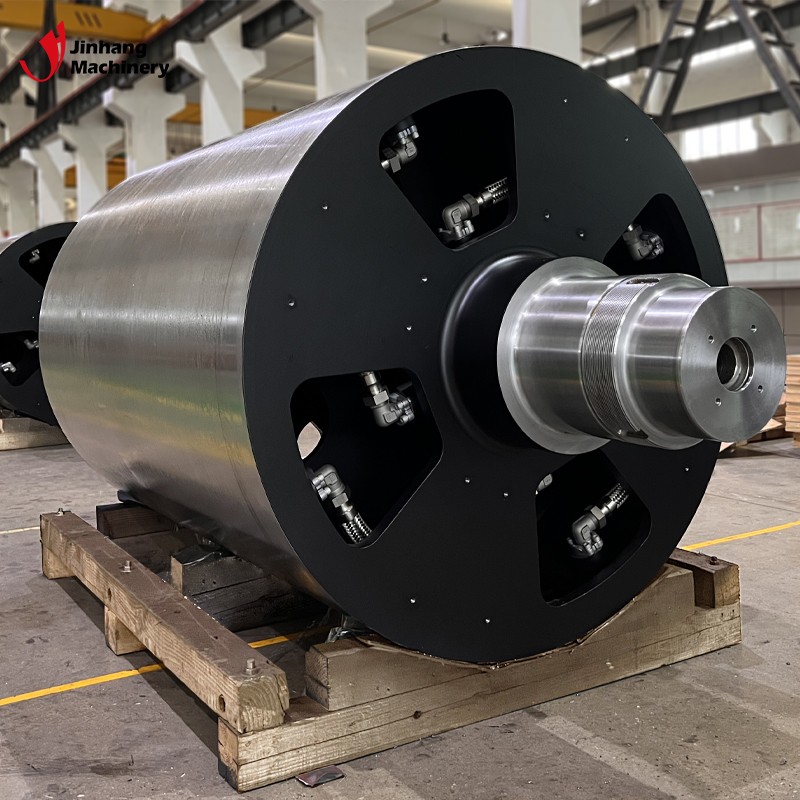
Are cooling rollers used to improve surface quality?
In many processes, cooling rollers not only cool the material but also improve its surface quality.
Mirror-finish cooling rollers can provide:
• Excellent surface polishing effect
• Smooth and glossy material surface
• Suppression of fine lines
• Uniform surface texture
The material surface is still in a pliable state immediately after leaving the heating zone. The precise mirror contact of the cooling roller allows for a higher surface quality.
This also means:
Cooling rollers are crucial for the surface quality of many high-end materials.
Do chill rollers affect the stability of the material's internal structure?
Cooling is not only a surface behavior but also a crucial stage in the evolution of the internal structure. After heating, the molecules in a material are in a highly active state, requiring chill rollers to gradually stabilize them.
The effects of chill rollers on the internal structure include:
1. Controlling the formation rate of crystal structures
Different cooling rates result in different grain sizes.
2. Controlling molecular chain orientation
Continuous cooling helps maintain the stretching orientation of the material.
3. Uniform internal material density
Uneven cooling can easily lead to defects in the internal structure.
All of this illustrates that:
Cooling rollers are a crucial part of quality control for the internal structure of materials.
Are cooling rollers used to improve the mechanical properties of materials?
Yes, improving mechanical properties is also one of the important uses of cooling rollers.
For example:
• Cooling rate affects material strength
• Uniform cooling prevents localized embrittlement or softening
• Rapid surface curing increases wear resistance
• Uniform internal structure improves toughness
Cooling rollers not only support material forming but also determine the quality grade of the formed material.
Does the temperature control of chill rollers affect production line efficiency?
The temperature stability of the chill rollers and the flow channel design directly determine the speed and efficiency of the production line.
1. Sufficient cooling rate → Shorter cycle time → Increased efficiency
Insufficient cooling prevents the material from proceeding to the next process.
2. Unstable temperature → Causes quality fluctuations → Affects production rhythm
Cooling rollers need to be matched with the tension system, traction speed, and heating roller system.
3. Accurate cooling → Avoids rework → Reduces costs
Overcooling or uneven cooling will cause quality defects.
Therefore:
The temperature performance of chill rollers is a crucial factor affecting the efficiency of the entire production line.
Can cooling rollers reduce residual stress on the product surface?
After high-temperature materials undergo stretching, extrusion, and surface forming, significant thermal stress exists internally. Cooling rollers, by controlling the cooling rate, can effectively reduce this stress.
The effects include:
• Reducing warping caused by residual stress
• Reducing deformation in subsequent processes
• Improving dimensional stability
• Enhancing long-term product performance
Therefore, cooling rollers are used not only for cooling but also for stress relief.
What role do cooling rollers play in improving production consistency?
Any production line requires continuous and stable product output, and the role of cooling rollers directly impacts consistency.
Cooling rollers provide:
• Stable temperature output
• Uniform cooling profile
• Fixed contact pressure
• Consistent surface quality
• Reliable thickness and dimensional control
These are all important guarantees for industrial production consistency.
In short:
The performance of cooling rollers determines whether a product possesses industry-level stability.
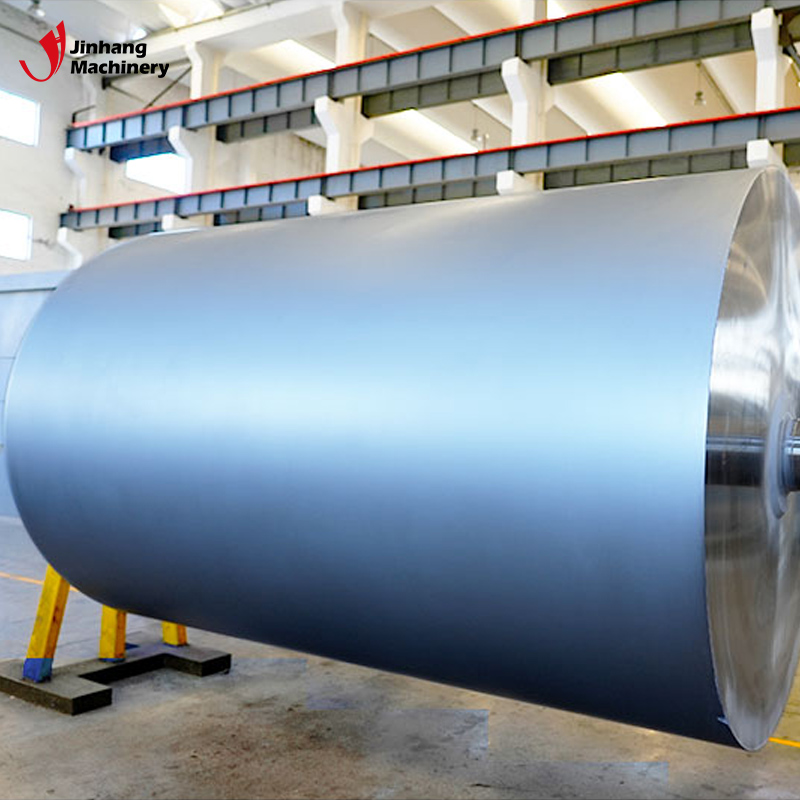
Does the use of chill rollers include transition control between materials and processes?
Yes. Cooling rollers serve as a transitional medium between many process stages, ensuring materials maintain their desired state during movement.
These include:
• A smooth transition from heating to cooling zones
• A stable transition from a softened state to a solid state
• A balancing process from a plastic to a shaped state
This is one of the key reasons why chill rollers are indispensable on industrial production lines.
Is there a direct relationship between the structural design of chill rollers and their applications?
Cooling rollers are not merely hollow rollers; their internal structure is closely related to their intended use:
• Internal spiral channels maintain uniform coolant distribution
• A perfectly symmetrical channel design ensures minimal surface temperature differences
• Surface material adapts to high contact pressure
• Surface finish adapts to calendering or shaping requirements
• Dynamic balancing design ensures stable operation at high speeds
These structural characteristics are all designed to better achieve cooling applications.
What are industrial cooling rollers used for?
The applications of chill rollers cover the following key aspects:
1. Rapid cooling and curing of materials
2. Controlling product surface condition and smoothness
3. Stabilizing material thickness and dimensions
4. Reducing internal residual stress
5. Improving material mechanical properties
6. Providing process transition and tension stability
7. Ensuring production consistency and high-quality output
8. Preventing material deformation and warping
9. Supporting the overall rhythm of continuous production lines
In other words:
Industrial cooling rollers are key temperature control and stabilization structures in the process of material processing from high temperatures to final molding, and are decisive components for the quality of many industrial products.