
Why are oil-guided industrial heating rollers more stable than electrically?
In many continuous production scenarios such as industrial heat treatment, coating, calendering, papermaking, film stretching, lithium battery separators, and rubber and plastic processing, heating rollers, as key temperature control components, directly determine the finished product quality, production capacity efficiency, and process consistency of the production line.
In modern industry, heating rollers are mainly categorized into two types:
• Oil-guided (heat transfer oil circulation) heating rollers
• Electrically heated rollers
Both can achieve precise temperature control, but it has long been generally believed in the industry that: Heat transfer oil-heated rollers generally have better overall stability than electrically heated rollers.
This "stability difference" stems from multiple levels of structure, physical properties, heat transfer mechanisms, and process logic, not just the superiority or inferiority of the temperature control system.
This article will provide a professional and in-depth analysis of why oil-guided industrial heating rollers exhibit higher stability under many operating conditions.
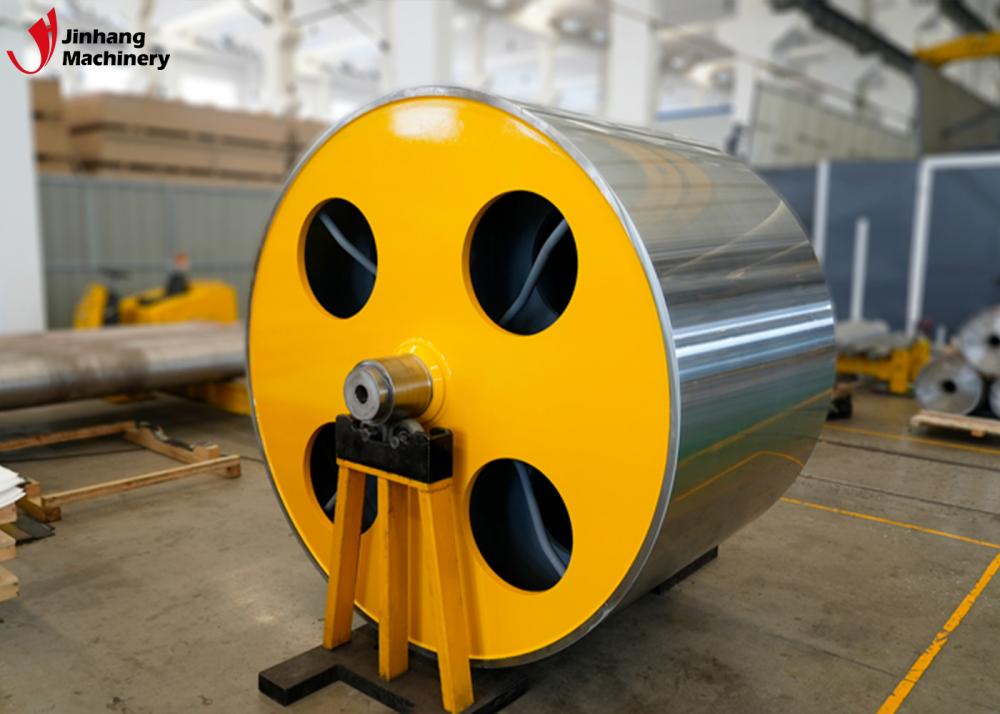
What are the fundamental structural differences between oil-guided heating rollers and electrically heated rollers?
To understand why heat transfer oil-heated rollers are more stable, it is essential to first clarify the differences in their structure and heating methods.
1. Heating Method of Oil-Guided Heated Rollers
Oil-guided heated rollers have precisely arranged spiral flow channels or multi-ring channels inside. The heat source comes from circulating high-temperature heat-conducting oil. The heating system provides heat from an external heater, which then pumps the hot oil into the heated roller.
It has the following characteristics:
• Continuous flow of hot oil
• Continuous and uniform heat input
• Temperature fluctuates slightly around the set value
• Thermal radiation, convection, and conduction work together
Essentially, it is a "dynamic thermal equilibrium system."
2. Heating Method of Electric Heated Rollers
Electric heated rollers have embedded electric heating tubes or heating plates inside, directly heating the roller body through resistance heating.
It has the following characteristics:
• The heat source is multiple electric heating elements
• Heat is "point-like heating"
• Heating is static conduction
• Temperature is continuously adjusted and compensated by an electronic control system
Essentially, it is a "local heating + control compensation system."
The difference between the two structures determines their subsequent temperature performance, operational stability, thermal compensation response, and temperature control behavior.
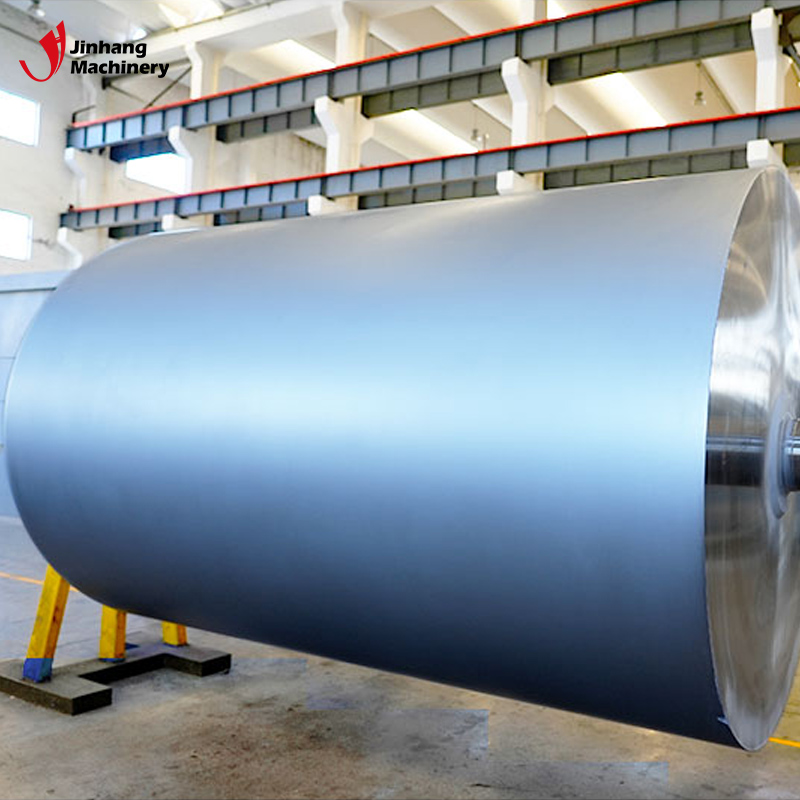
Why does the "fluidity" of heat transfer oil make the heating roller more stable?
The biggest structural advantage of oil-guided heating rollers compared to electric heating rollers is the fluidity of the heat transfer medium.
This fluidity provides a natural temperature stabilization mechanism for the heating roller.
Specifically, this manifests as follows:
1. Continuous flow ensures uniform heat replenishment
The continuous flow of hot oil means:
• Heat is continuously input from the external heater.
• Hot oil circulates stably.
• The temperature inside the roller will not drop due to localized heat loss.
It's equivalent to an automatically balancing "heat flow pool."
Electric heating, on the other hand, is a static system without a flowing medium; "heat compensation must wait for the temperature sensor to detect a change before the heating element is activated."
2. The flowing medium naturally eliminates localized temperature differences
Hot oil flows through the entire roller channel—high-temperature zone → cooler zone → then back to replenish heat. This flow process naturally achieves "heat exchange," gradually bringing the temperature closer to a uniform level.
Electric heating cannot achieve this because "heat is only replenished where the heating element is located."
3. Fluids possess heat capacity, naturally stabilizing temperature fluctuations
The specific heat capacity of heat-conducting oil is significantly greater than that of the metal roller itself. Therefore:
The presence of hot oil makes the heated roller less susceptible to temperature fluctuations due to instantaneous environmental changes.
In summary:
The combination of fluidity and heat capacity allows the oil-conducting heated roller to form a self-balancing system, while the electrically heated roller relies on a controller for compensation, thus its stability is naturally inferior to that of the oil-conducting system.
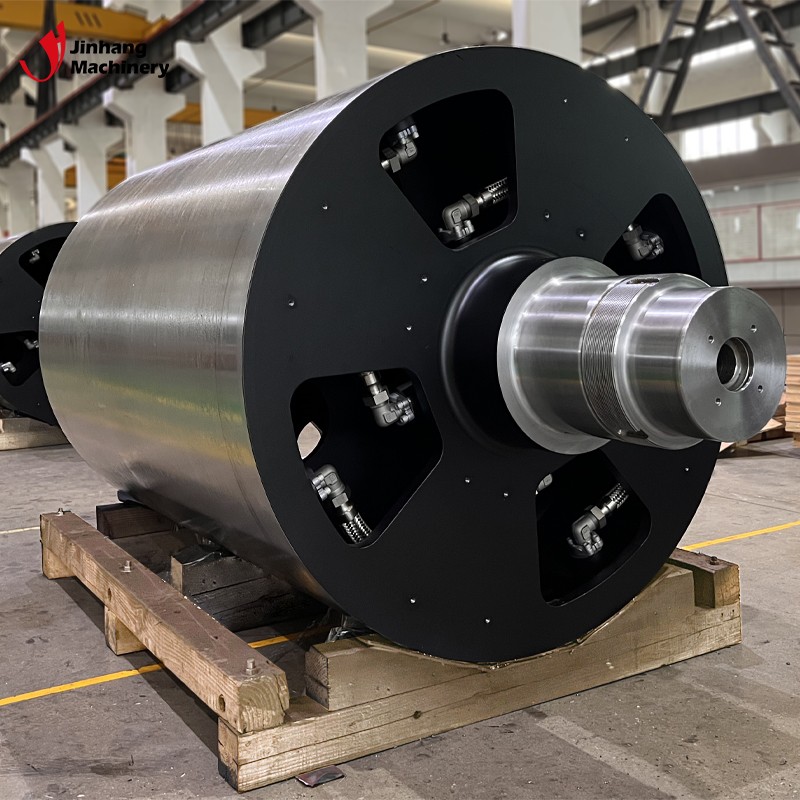
Why is the temperature more uniform in oil-conducting heated rollers?
Temperature uniformity is a crucial indicator of the stability of heated rollers.
The core reasons why oil-conducting heated rollers are superior to electrically heated rollers include:
1. Hot oil covers the entire interior of the roller, resulting in naturally uniform heat distribution
The flow path of the hot oil almost covers the entire effective area of the roller, ensuring continuous heat reception throughout.
In contrast, the position of the heating elements in an electrically heated roller determines the heat distribution; uneven placement directly affects the heat distribution.
2. Liquid heat transfer media possess "flexible heat conduction" characteristics
Hot oil transfers heat through convection, a highly efficient method of temperature equalization.
However, electric heating primarily generates heat in a point-like manner, relying on metal conduction for diffusion, which is inherently less uniform than convection.
3. The temperature of the hot oil is centrally controlled by an external heater, resulting in higher stability
The external heating furnace has a large-volume oil tank, minimizing temperature fluctuations, thus ensuring a more stable oil temperature entering the roller.
Electric heating elements generate heat at multiple points, and temperature consistency is affected by element lifespan and differences in heating output.
Why are electrically heated rollers more prone to temperature differences and localized overheating?
The fundamental reasons for the weaker temperature stability of electrically heated rollers include:
1. The heating elements are distributed in a point-like manner, making perfect uniformity of heating impossible
Even heating tubes of the same model exhibit:
• Differences in resistance
• Inconsistent attenuation after use
• Different thermal responses
This leads to:
The coexistence of localized high-temperature and low-temperature points.
2. Heat diffusion from a point to a surface takes time, resulting in an uneven process
The heat propagation path of an electrically heated roller is:
Heating tube → High temperature near the heating tube → Metal conduction diffusion → Surface temperature tends to be uniform.
However, conduction is slow, easily causing dynamic unevenness.
3. Temperature control depends on sensor location
If the temperature at the sensor location is normal, it doesn't mean other areas are normal.
In other words:
Electrically heated rollers are most prone to the situation of "uniform surface temperature, seemingly fine, but actually localized overheating."
This is why many high-precision processes prefer to use oil-heated rollers.
Why do oil-heated rollers have the least temperature fluctuation?
The temperature fluctuation of oil-heated rollers can usually be stabilized within a very small range. The reasons include:
1. The high specific heat capacity of heat transfer oil provides a natural "thermal buffer."
The higher the specific heat capacity, the less prone the temperature is to fluctuation.
The heat transfer oil acts as a huge "thermal buffer pool," absorbing and smoothing out any small changes in heat demand.
Electrically heated rollers lack this buffer, resulting in a high frequency of heating element start-stop cycles and large temperature fluctuations.
2. The oil heating system provides continuous heating, eliminating "start-stop" fluctuations
Electrically heated rollers rely on an "on-off-on-off" adjustment method (SSR or PID control), inevitably causing fluctuations. The hot oil system features:
• Continuous circulation
• Continuous reheating
• Continuous temperature control
Therefore, the output temperature is naturally more stable.
3. The larger the system, the more stable the temperature
External heating furnaces typically have large oil storage capacity and high temperature inertia, making the temperature of the oil-guided heating roller almost unaffected by instantaneous operating conditions.
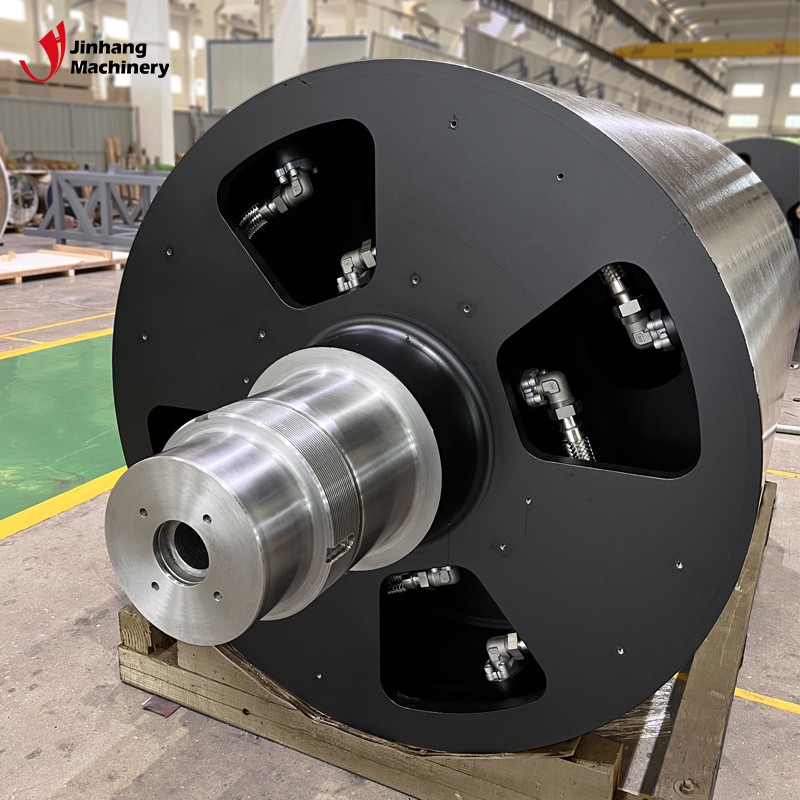
Why does the oil-guided heating roller exhibit greater stability during long-term continuous operation?
The physical properties of the heat transfer oil and the system structure determine its suitability for long-term continuous operation:
1. Minimal heat loss after hot oil circulation
The hot oil maintains a constant temperature through the heating furnace, resulting in minimal temperature change upon returning to the roller.
2. Stable system pressure and constant flow rate
The circulation pump maintains a constant flow rate, ensuring uniform heat distribution.
3. The hot oil system is less susceptible to external environmental influences
For example, disturbances such as ambient cooling, fan exhaust, and material heat absorption can be quickly offset by the hot oil system.
Electrically heated rollers have limited compensation speed, making them prone to fatigue or thermal drift during long-term operation.
Why do many high-temperature processes prefer oil-conducting heated rollers?
This is because the upper temperature limit of heat transfer oil is much higher than the operating temperature that electric heating tubes can withstand.
1. Heat transfer oil systems can maintain long-term stability at high temperatures
High-quality heat transfer oil can typically operate stably for extended periods within the range of 200°C to 350°C, maintaining unchanged thermal properties.
2. While electric heating tubes can reach high temperatures, they experience rapid degradation and have a short lifespan
Prolonged exposure to high temperatures by electric heating elements leads to:
• Changes in resistance
• Decreased heating power
• Inconsistent localized degradation
• Shortened lifespan
This directly reduces the stability of the heated roller.
Therefore, in high-temperature and continuous operation scenarios, oil-conducting heated rollers are better able to maintain thermal stability.
In what aspects are electric heating rollers less stable than oil-conducting heated rollers?
The inherent limitations of electrically heated rollers can be summarized as follows:
• Temperature is determined by point heating, resulting in limited uniformity.
• Inconsistent lifespan of heating elements.
• Heat compensation depends on sensor location.
• High risk of melting, attenuation, and localized overheating.
• Lack of fluid circulation leads to a less smooth temperature response.
• Temperature control is on-off, resulting in significant fluctuations.
• Lack of a natural temperature buffer layer (such as hot oil).
These factors combined make electrically heated rollers less stable than oil-guided heated rollers in high-precision, high-speed, and high-load applications.
Why are oil-guided industrial heated rollers more stable than electrically heated rollers?
The fundamental reasons for the greater stability of oil-guided heated rollers include:
1. The fluidity of the hot oil allows for automatic thermal equilibrium.
2. The high specific heat capacity of the heat transfer oil naturally results in smaller temperature fluctuations.
3. The hot oil system provides continuous heating, independent of start-stop regulation.
4. More uniform temperature distribution within the heated roller.
5. The temperature control of the hot oil system is "holistic control," resulting in smaller errors.
6. Stronger high-temperature operating capability.
7. Significantly higher stability during long-term continuous operation.
8. Extremely low risk of localized overheating.
9. Unaffected by the degradation of electric heating elements.
Therefore:
In industrial fields with extremely high requirements for temperature uniformity, stability, and continuity, the system performance of oil-guided industrial heated rollers is generally superior to that of electrically heated rollers.
This is a key reason why the industry widely chooses heat transfer oil heated rollers.