Why Do Heating Rollers Require Spiral Channels?
In modern industrial thermal processing equipment, heating rollers have emerged as critical core components across various sectors, including plastic films, lithium-ion battery materials, textiles, papermaking, composite materials, steel rolling, and precision coating. For many continuous production systems, the heating roller serves not only a heating function but also directly determines the material's temperature uniformity, thickness stability, and surface quality.
Furthermore, as industrial processing precision continues to advance, industry requirements regarding temperature difference control for heating rollers have become increasingly stringent.
Many high-precision systems even demand the following:
•Minimal lateral temperature variation across the roller surface;
•Stable heating response;
•Uniform temperature maintenance during prolonged operation;
•Absence of "hot spots" or "cold spots" on the roller surface.
Consequently, the internal structural design of heating rollers has gradually become a key area of focus within the industry.
Among various designs, the "spiral channel" represents the most typical and prevalent internal structural configuration found in heating rollers.
However, at the same time, many have raised the following questions:
Why is it absolutely necessary for heating rollers to feature spiral channels?
If there were no internal channels—relying solely on circulation within a hollow cavity—would it still be possible to achieve temperature uniformity?
In reality, this is not merely a simple matter of structural choice; rather, it involves a range of core industrial thermal engineering issues, including:
•Heat distribution;
•Fluid circulation;
•Temperature difference control;
•Heat exchange efficiency;
•Thermal inertia balance;
•Roller surface stability;
and others.
Engineering professionals within the industry generally agree that the true challenge in controlling a heating roller lies not in the question of "can it heat up?" but rather in "can the entire roller surface maintain uniform heating over an extended period?"
The spiral channel design represents a critical structural solution specifically engineered to achieve this objective.
The Core Issue with Heating Rollers Is, In Fact, Temperature Difference
For many people, the understanding of heating rollers remains limited to the simple premise:
"As long as a thermal medium circulates internally, it will generate heat."
However, for modern industrial equipment, the truly critical factor regarding a hot oil roller is not merely the presence of heat, but rather:
•Whether the temperature is uniform;
•Whether the heat output is stable;
•Whether there are localized temperature disparities (hot or cold spots) on the roller surface.
This is because, as materials pass through the hot oil roller, they come into direct contact with its surface. If there is a significant temperature difference across the surface of a hot oil roller, it can easily lead to:
•Uneven material thickness;
•Differential shrinkage;
•Surface defects;
•Irregular adhesion;
•Unstable stretching.
This is particularly critical for:
•Optical films;
•Lithium-ion battery separators;
•Precision-coated materials;
•Ultra-thin films;
where even a minute temperature difference on the heating roller's surface can compromise the final product quality.
Consequently, industrial requirements for heating rollers have never been merely about "heating," but rather about "uniform heating."
Why are standard hollow heating rollers prone to temperature differences?
Many people assume:
Since the heating medium itself is fluid, it will naturally circulate even if the heating roller lacks internal flow channels.
This assumption is not entirely incorrect.
However, the problem lies in this:
Natural circulation does not equate to uniform circulation.
If a heating roller features only a standard hollow internal structure, the heating medium often exhibits:
•Uneven flow rates;
•Localized stagnation;
•Short-circuiting of flow;
•Thermal stratification.
These issues become particularly pronounced within large-scale heating rollers.
This is because the heating medium typically prioritizes—and flows through—the path of:
Least resistance.
The result is:
Some areas experience robust circulation, while others experience weak circulation.
Ultimately, this leads to the formation of the following on the heating roller's surface:
•Hot spots;
•Cold spots;
•Temperature bands.
For standard, low-precision equipment, such discrepancies may not be noticeable.
However, for high-precision industrial manufacturing, such temperature differences are often unacceptable.
Why are hot oil rollers particularly susceptible to "lateral temperature differences"?
Thermal engineers in the industry point out that the most challenging aspect to control in a hot oil roller is not the axial temperature, but rather the lateral temperature difference.
A "lateral temperature difference" refers to:
Temperature inconsistency across the width of the hot oil roller.
Wide-format hot oil rollers, in particular, are more prone to exhibiting:
•A hot center;
•Cold edges;
•Localized temperature fluctuations.
The underlying reason is this:
If the heating medium circulates unevenly within the roller, it results in an unbalanced distribution of thermal energy.
Consequently, as the material passes over the hot oil roller, different lateral sections of the material are exposed to varying amounts of heat. Ultimately, this results in:
•Inconsistent lateral material shrinkage;
•Variations in tension;
•Fluctuations in thickness.
Therefore, the design of the internal fluid path within a hot oil roller is absolutely critical.
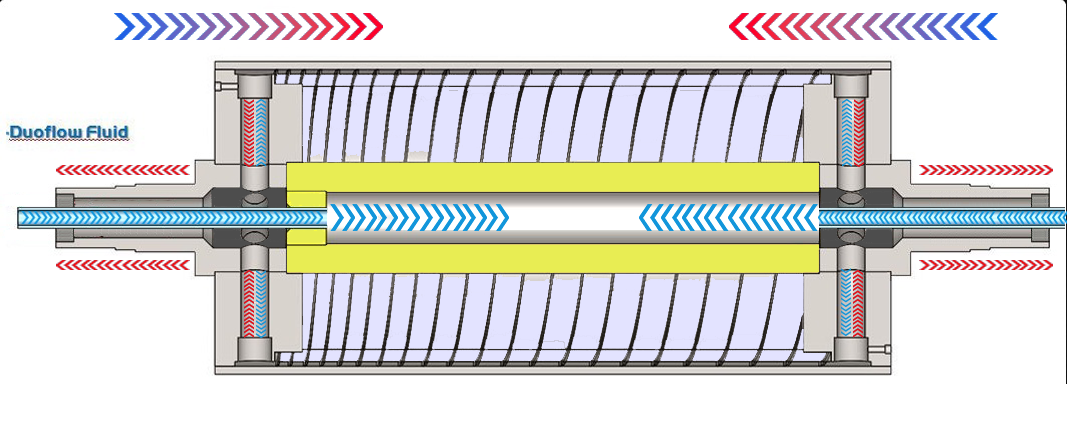
A helical flow channel essentially facilitates "forced uniform circulation."
The reason helical flow channels are widely adopted in hot oil rollers is not simply to make the structure more complex.
Its core objective is, in fact:
To force the thermal medium to flow uniformly.
Thanks to the helical structure, the medium inside the hot oil roller does not merely take the "path of least resistance" (the shortest route).
Instead, it is compelled to circulate along the entire length of the roller body.
This enables the thermal medium to:
•Cover a larger surface area;
•Increase the contact area;
•Enhance flow uniformity;
•Minimize localized stagnation.
Consequently, a helical flow channel effectively serves to "actively control heat distribution."
This is a primary reason why many high-precision hot oil rollers mandate the use of helical flow channels.
Why do hot oil rollers not utilize straight-through flow channels?
Some might wonder:
If circulation is required, why not simply employ a straightforward, straight-through flow channel?
The reason is that, while a straight-through structure offers lower flow resistance, it often leads to:
The thermal medium passing through too rapidly.
In other words:
The flow velocity is present, but the heat exchange is insufficient.
Because the residence time of the thermal medium is too brief, the heat has not yet fully diffused before the medium exits the hot oil roller.
This frequently results in:
•Elevated temperatures in localized areas;
•Uneven heat distribution;
•Temperature differentials across the roller surface.
A helical flow channel, conversely, extends the flow path of the medium.
This allows the thermal medium to remain inside the hot oil roller for a longer duration.
As a result, heat exchange becomes significantly more thorough.
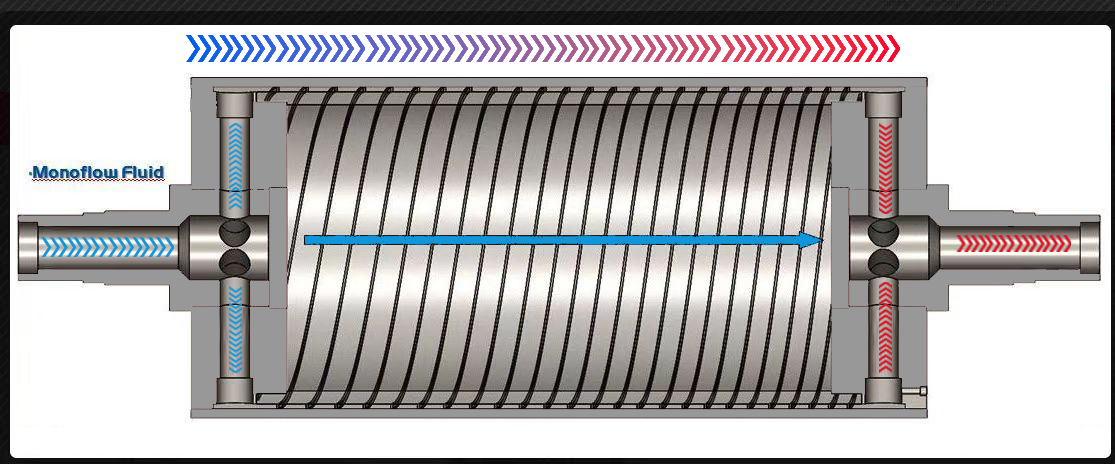
Helical flow channels also enhance the internal turbulence effect within the heating roller
In the field of industrial heat exchange, there exists a crucial concept:
Turbulence.
Turbulence refers to a state where the fluid no longer "glides smoothly" but instead adopts a constantly shifting flow pattern.
This is because overly smooth (laminar) flow tends to foster the formation of:
•Boundary layers;
•Heat exchange "dead zones" (stagnant areas);
•Localized regions of low flow velocity.
A helical flow channel, however, continuously alters the direction of the fluid flow.
Thereby intensifying the internal turbulence effect.
This implies that:
The thermal medium is able to make more intimate contact with the inner wall of the heating roller.
Thus, a helical flow channel serves not merely to "guide the flow," but—more importantly—to boost the efficiency of heat exchange.
Is it truly impossible to use a heating roller without internal flow channels?
In reality, not all heating rollers strictly require the use of spiral flow channels.
Certain low-temperature, small-scale, or low-precision heating rollers can indeed utilize:
•Simple hollow cavity structures;
•Basic flow-guiding structures;
•Fundamental circulation systems.
Under these operating conditions—due to:
•The relatively small size of the roller body;
•Less stringent requirements regarding temperature uniformity;
•Lower thermal loads—
it is possible to achieve basic heating functionality even without complex internal flow channels.
However, the issue arises here:
As the size of the heating roller increases and precision requirements become more demanding, the limitations of simple hollow cavity structures become increasingly apparent.
This is particularly true in applications involving:
•Wide-format equipment;
•High-temperature processes;
•High-precision manufacturing—
where heating rollers lacking properly designed flow channels often struggle to maintain stable temperature uniformity.
Why do large hot oil rollers rely more heavily on spiral flow channels?
The larger the hot oil roller, the more complex the internal heat distribution becomes.
Specifically, within large, wide-format hot oil rollers, there exist:
•Longer heat conduction pathways;
•More complex fluid circulation patterns;
•More significant thermal losses.
Without controlled flow channels, the thermal medium is prone to issues such as:
•Overheating in the central region;
•Insufficient circulation in the edge regions;
•Localized temperature decay.
Consequently, large hot oil rollers typically rely more heavily on spiral flow channels.
This is because only through forced flow guidance can the internal heat distribution across the entire roller be effectively balanced.
Heating Roller Flow Channel Design Is, in Essence, Pressure Design
Many people focus solely on the temperature of the heating roller while overlooking a critical fact:
The flow channels themselves also directly influence internal pressure.
If a heating roller lacks a properly designed internal flow channel system, the flow dynamics of the thermal medium can easily spiral out of control.
This can lead to issues such as:
•Excessively high flow velocities in specific localized areas;
•Stagnation or near-zero flow in certain regions;
•Uneven distribution of internal pressure.
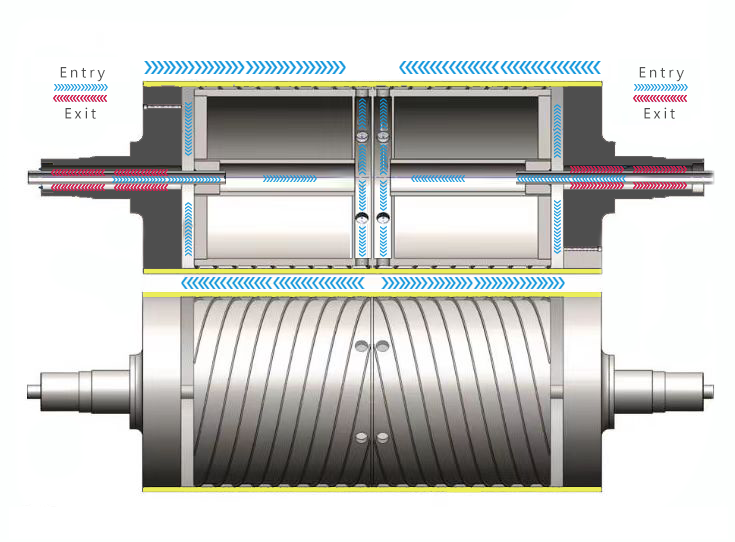
Beyond facilitating efficient heat exchange, spiral flow channels also serve to:
•Balance internal pressure distribution;
•Stabilize circulation dynamics;
•Minimize flow rate fluctuations.
Therefore, the design of the flow channels impacts not only the temperature profile but also the overall operational stability of the hot oil roller.
Why Can't Heating Rollers Rely Solely on the Thermal Conductivity of the Metal?
Some argue that:
Even if the internal fluid flow is uneven, the metal material itself possesses thermal conductivity; therefore, the final surface temperature of the roller will eventually tend toward uniformity.
This premise applies only to:
•Small-sized heating rollers;
•Low-precision operating conditions;
•Low-temperature environments.
This is because, while metal does conduct heat, the rate at which it does so is ultimately limited.
This is particularly true for large heating rollers, where the distance over which heat must be transferred is significantly greater.
If the internal heat source distribution is inherently uneven, relying solely on natural thermal diffusion through the metal makes it extremely difficult to completely eliminate temperature differentials.
Consequently, high-precision heating rollers cannot rely solely on the thermal conductivity of the metal; instead, they must actively control heat distribution through the use of internal flow channels.
Why are the internal flow channels in many high-end heating rollers becoming increasingly complex?
As industrial precision standards rise, the internal flow channel designs within many heating rollers have evolved beyond simple spiral configurations.
Some high-end heating rollers now incorporate:
•Dual-spiral structures;
•Multi-zone circulation systems;
•Layered flow channels;
•Turbulence-inducing guide structures.
The reason for this lies in the fact that:
Industry requirements regarding the control of temperature differentials in heating rollers are becoming increasingly stringent.
For in the context of modern industrial production:
Temperature differentials affect not only product quality but also:
•Tension stability;
•Material shrinkage;
•Surface gloss;
•Adhesion characteristics.
As a result, the internal structural design of hot oil rollers has gradually emerged as a core element of thermal engineering technology.
The True Critical Factor for Heating Rollers Is Thermal Equilibrium
Industry experts generally agree that:
The most fundamental issue concerning heating rollers is, at its core, the achievement of thermal equilibrium.
"Thermal equilibrium" refers to something more than just:
"The overall temperature reaching a specific setpoint."
Rather, it signifies:
A state in which every single area across the entire surface of the roller maintains a stable, uniform, and consistent thermal condition.
The reason spiral flow channels are so crucial is that they assist the heating roller in establishing and maintaining this more stable thermal equilibrium.
Heating Rollers Lacking Flow Channels Struggle to Maintain Stable Temperature Control Over Time
Based on the prevailing consensus within the industry, heating rollers that lack internal flow channels are not entirely incapable of functioning.
However, for modern high-precision industrial equipment, relying solely on simple internal cavity circulation typically makes it extremely difficult to maintain stable control over temperature differentials over the long term.
This is particularly true under operating conditions characterized by:
•Large dimensions;
•High temperatures;
•High speeds;
•High precision requirements.
Under such conditions, if a heating roller lacks a properly designed internal flow channel system, it becomes prone to issues such as:
•Uneven heat distribution;
•Widening lateral temperature differentials;
•The formation of localized "hot spots" and "cold spots";
•Fluctuations in temperature control.
The core value of a spiral flow channel lies precisely in its ability—through forced guidance, enhanced turbulence, and an extended heat exchange path—to ensure that the thermal medium circulating within the heating roller covers the entire roller body with greater uniformity.
Consequently, in the context of modern industrial production, whether a heating roller possesses a well-engineered flow channel structure is often no longer merely a matter of "structural design"; rather, it serves as the critical foundation that determines:
•Temperature differential stability;
•Heat exchange efficiency;
•Product consistency;
•Continuous production stability.