
Why Do Industrial Hot Oil Rollers Require High Precision in Temperature Uniformity?
In modern high-precision manufacturing, temperature control is no longer merely an auxiliary parameter; it is a core variable that directly determines product quality, production efficiency, and equipment stability. Particularly in sectors such as film manufacturing, lithium-ion battery coating, plastic calendering, optical material processing, printing and lamination, and new energy equipment manufacturing, the temperature control capability of industrial rollers often directly impacts the final product's thickness uniformity, surface quality, and dimensional stability. Against this backdrop, industrial hot oil rollers have become indispensable equipment in high-end industrial production lines.
An industrial hot oil roller is essentially a functional industrial roller heated internally by circulating thermal oil. By circulating thermal oil within the roller body, heat is evenly transferred to the roller surface, thereby providing a stable and controllable thermal environment for material processing. Compared to steam-heated or electrically heated rollers, industrial hot oil rollers offer significant advantages—such as a wide temperature control range, stable thermal inertia, minimal temperature fluctuation, and high control precision—making them widely adopted in industries requiring precision thermal processing.
However, when selecting industrial hot oil rollers, many enterprises overlook a critical question: why is there such a stringent requirement for temperature uniformity (minimizing temperature differences) across the roller surface? Why does the industry emphasize that the temperature difference across the roller surface must be controlled within ±1°C—or even within ±0.3°C for certain high-end applications? Furthermore, why is the internal flow channel design considered the core factor determining the roller's performance?
In reality, these two issues are closely interconnected. The temperature uniformity of an industrial hot oil roller depends largely on the rationality of its internal flow channel structure. If the flow channel design is poor, it is difficult to ensure uniform surface temperature, even when using high-performance thermal oil and advanced temperature control systems.
This article provides an in-depth analysis of the logic behind temperature uniformity control in industrial hot oil rollers and the design of their internal flow channels.
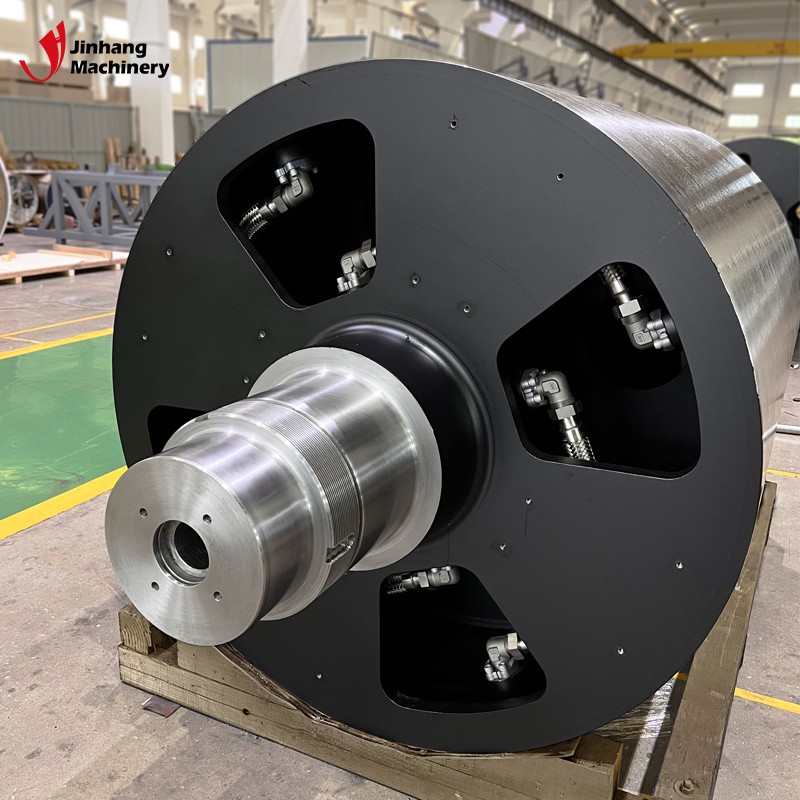
Why Have Industrial Hot Oil Rollers Become Key Equipment in High-Precision Manufacturing?
To understand the importance of industrial hot oil rollers, one must first grasp the role industrial heating rollers play in production. For many materials, heating is not the end goal itself, but rather a means to achieve specific changes in material properties. For instance, plastic films soften upon heating, facilitating calendering; lithium battery electrode sheets achieve more stable roller-pressing when heated; and optical films require exceptional temperature uniformity during the heat-setting stage to eliminate internal stress.
This implies that industrial hot oil rollers must not only be "hot" but also "uniformly hot."
If a specific area on the roller surface is too hot, the material passing over it may suffer from localized overheating, potentially leading to excessive softening, stretching deformation, or even surface scorching. Conversely, if an area is too cool, insufficient heating can result in inadequate calendering, abnormal surface tension, or poor bonding.
Taking lithium battery electrode sheet production as an example, industry data indicates that if the error in electrode compaction density exceeds 1.5%, the battery's cycle life may drop by 5% to 12%. One major factor contributing to these fluctuations in compaction density is excessive temperature variation across the surface of the industrial hot oil roller.
This impact is even more pronounced in the field of optical films. Optical films typically have thicknesses in the range of tens of microns; a temperature difference of just 2°C during thermal processing can cause shrinkage rate variations exceeding 0.3%, ultimately affecting light transmission and haze metrics.
Therefore, the core objective of industrial hot oil rollers is not merely to generate heat, but to achieve high-precision thermal uniformity.
Why is high precision regarding temperature uniformity required for industrial hot oil rollers?
The fundamental reason lies in the increasingly stringent requirements of modern manufacturing regarding dimensional accuracy and material property consistency. Temperature variations across the roller surface essentially translate into performance discrepancies during material processing.
1. Temperature variations lead to inconsistent thermal expansion
It is a fundamental physical principle that all materials expand when heated. Varying temperatures across different areas mean varying degrees of thermal expansion.
Consider an industrial hot oil roller with a surface temperature of 198°C on the left side and 202°C on the right; while a 4°C difference might seem minor, for polymer materials, this gap can be sufficient to cause significant processing deviations.
For example, the linear thermal expansion coefficient of PET film at high temperatures is approximately 60–80×10⁻⁶/°C. A lateral temperature difference of 4°C can result in micron-level dimensional changes in wide-web materials. While the impact might be negligible for standard packaging films, such deviations are unacceptable for electronic and optical films.
Consequently, high-end industrial hot-oil rollers typically require temperature control within the following ranges:
•General industrial applications: ±3°C
•High-precision films: ±1°C
•Optical materials: ±0.5°C
•Semiconductor materials: ±0.3°C
These figures demonstrate that temperature control for industrial hot-oil rollers has effectively entered the realm of precision manufacturing.
2. Temperature differences cause thermal deformation of the roller body
Beyond affecting the material, temperature differences also impact the industrial hot-oil roller itself.
Industrial hot-oil rollers are typically made of steel, a material subject to thermal expansion. Uneven internal heating causes varying degrees of expansion across different sections of the roll body, leading to thermal deformation.
Common issues include:
•Bulging in the center of the roller
•Localized depressions on the roller surface
•Reduced cylindricity
•Deteriorated dynamic balance
These issues directly compromise the mechanical precision of the roller.
For instance, consider a roller with a diameter of 500 mm and a length of 3000 mm; an axial temperature difference of 8°C could result in a thermal expansion differential of approximately 0.1 mm. While this might be insignificant for standard machinery, in high-precision coating equipment, it is enough to cause uneven product thickness.
3. Temperature differences affect production stability
Industrial hot-oil rollers impact not only the product but also the stable operation of the entire production line.
Excessive temperature differences alter the distribution of material tension, leading to:
•Web wandering (misalignment)
•Wrinkling
•Localized stretching
•Uneven winding
Many companies mistakenly attribute web wandering to tension system issues, when the root cause often lies in uneven temperature distribution across the industrial hot-oil roller.
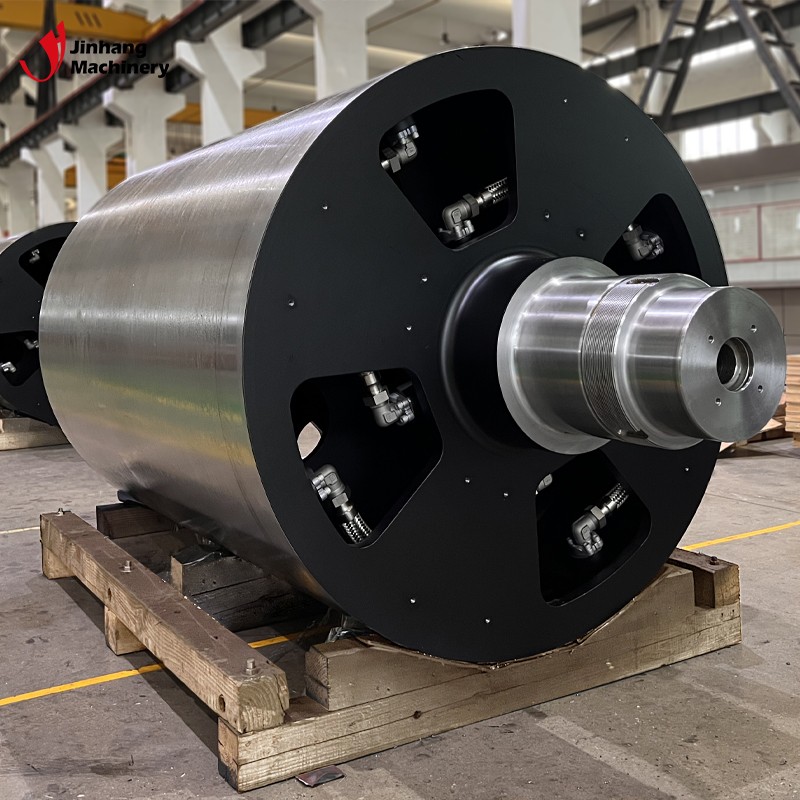
Why are internal flow channels in hot-oil heating rollers important?
The temperature control performance of an industrial hot-oil roller ultimately depends on how heat is transferred from the thermal oil to the roller surface. The design of the internal flow channels is the core factor in this process. The flow channels can be thought of as the "vascular system" within an industrial hot-oil roll. Heat-transfer oil circulates through them, continuously delivering heat to various zones of the roll body.
With a well-designed flow channel system, the oil flows at a uniform rate and heat exchange is efficient, ensuring a consistent roller surface temperature. Conversely, flaws such as dead zones, flow short-circuiting, or uneven flow distribution can lead to localized hot spots or cold zones.
Therefore, the design of the flow channels directly determines three key performance indicators for industrial hot-oil rollers:
•Heating rate
•Temperature uniformity (precision)
•Thermal stability
Common Flow Channel Structures for Hot-Oil Heating Rollers
There is no single standard for the internal flow channels of industrial hot-oil rollers; different industries employ different designs.
1. Straight-through flow channels
This is the most basic structural design for industrial hot-oil rollers.
Heat-transfer oil enters at one end, flows axially, and exits at the other. The structure is simple and inexpensive to manufacture, making it suitable for small-to-medium-sized industrial hot-oil rollers.
While easy to fabricate, it has a distinct disadvantage: significant axial temperature variation.
As the oil flows, it continuously releases heat, causing its temperature to drop by the time it reaches the outlet; consequently, the inlet zone is often hotter than the outlet zone.
Typically, the temperature variation for this type of roller is controlled within a range of ±3°C.
Applications include:
•Standard calendering
•Packaging production
•Low-to-medium precision lamination equipment
2. Spiral flow channels
To address the temperature variation issues associated with straight-through channels, many high-end industrial hot-oil rollers utilize spiral flow channels.
The heat-transfer oil follows a spiral path, which extends the heat exchange distance and enhances turbulence, thereby improving heat exchange uniformity.
The advantages of spiral flow channels include:
First, more thorough heat exchange.
Second, more uniform flow velocity.
Third, a reduction in localized dead zones.
Industry experience shows that spiral flow channels can reduce temperature variation by 30% to 60% compared to standard straight-through rollers.
Consequently:
•Lithium-ion battery coating
•Optical film production
•High-end printing
...often utilize industrial hot-oil rollers with spiral flow channels.
3. Multi-chamber parallel flow channels
This represents one of the most complex designs for high-end industrial hot-oil rollers. The interior of the roller body is divided into multiple independent flow channel zones, each participating in a parallel circulation circuit. This configuration significantly improves both axial and radial temperature uniformity.
The advantages of a multi-chamber structure include:
•Precise flow distribution
•Strong localized temperature control capabilities
•Rapid thermal response
High-end industrial hot oil rollers can maintain temperature uniformity within ±0.5°C.
However, there are notable disadvantages:
•High manufacturing costs
•Strict welding precision requirements
•Demanding internal cleaning requirements
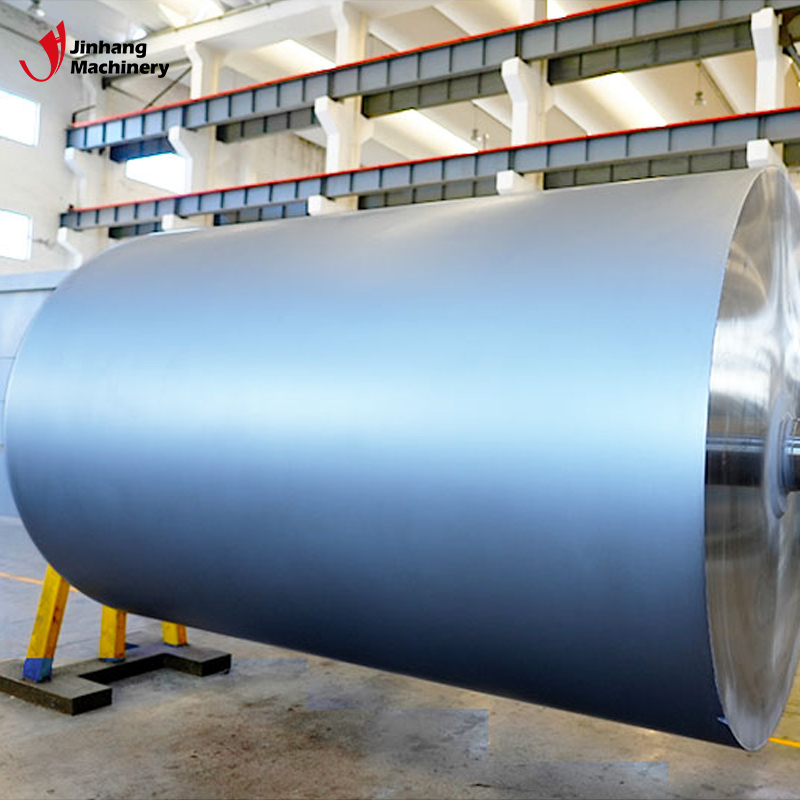
What factors must be considered when designing flow channels for industrial hot oil rollers?
An excellent flow channel design is not merely a matter of drilling holes; it involves an integrated design approach combining thermodynamics, fluid mechanics, and mechanical engineering.
1. Flow Velocity Control
If the flow velocity of the thermal oil is too low, heat transfer efficiency suffers.
Conversely, excessively high flow velocity leads to:
•Increased pressure drop
•Higher pump power requirements
•Increased energy consumption
The typical flow velocity range for thermal oil in these rollers is:
0.8–3 m/s
This is considered the optimal range within the industry.
2. Reynolds Number and Turbulence
Generating moderate turbulence inside the roller is desirable.
This is because turbulence enhances heat transfer efficiency.
In a laminar flow state, the temperature is high at the center of the oil stream and low at the boundaries, resulting in poor heat exchange efficiency. Well-designed rollers typically utilize channel geometry to induce turbulence.
3. Minimizing Dead Zones
Dead zones are a major issue in the design of industrial hot oil rollers.
Dead zones in the flow channel result in:
•Sluggish oil flow
•Localized overheating
•Increased risk of carbon deposits
Over time, these deposits can even clog the flow channels.
Therefore, high-end designs aim to avoid:
•Sharp angles
•Sudden expansions
•Sudden contractions
FAQ
Q1: Are industrial hot oil rollers superior to steam rollers?
Generally, yes, for applications requiring high-precision temperature control, as hot oil rollers offer better temperature uniformity and stability.
Q2: What constitutes excellent temperature uniformity for industrial hot oil rollers?
Within ±3°C for standard applications; high-end applications typically require ±1°C or even tighter tolerances.
Q3: Is a more complex flow channel design always better?
Not necessarily. While complex flow channels enhance performance, they also increase the difficulty of manufacturing and maintenance.
Q4: What is the maximum heating temperature for industrial hot oil rollers?
The typical range is 150°C to 350°C, though specialized designs can achieve higher temperatures.
Q5: Why is there such a wide price variation among industrial hot oil rollers?
It primarily depends on the roller body material, machining precision, flow channel structure, and temperature control requirements.